








Artificial intelligence (AI) has moved from sci-fi to everyday reality. From automated workflows and creative content generation to advanced coding assistance and intelligent analytics, AI tools are now essential for professionals, students, creators, and businesses alike. As we advance through 2025, the AI landscape continues evolving at a rapid pace with tools becoming smarter, more accessible, and more impactful than ever before.
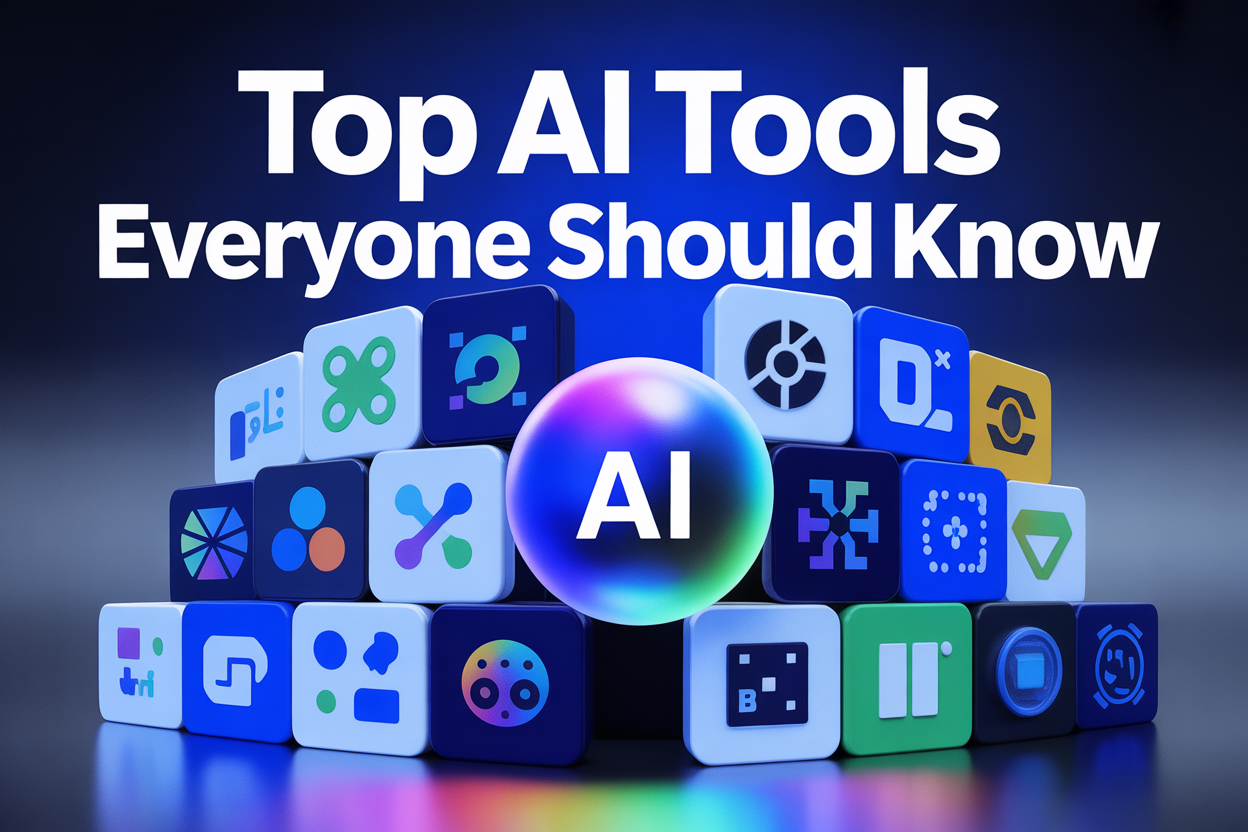
In this comprehensive guide, we explore the top AI tools everyone should know what they are, how they work, and why they matter. Whether you’re a marketer, developer, entrepreneur, or content creator, this list will help you harness the power of AI to boost productivity and creativity.
Table of Contents
Why AI Tools Matter in 2025
Today’s AI tools are no longer limited to simple chatbots or robotic assistants. They have become multimodal systems capable of handling text, visuals, speech, coding, automation, and decision-making tasks with unprecedented accuracy and speed. According to recent reports, AI is increasingly being integrated across CRM systems, workflow automation, and creative suites prompting a surge in adoption by professionals across industries.
With such rapid change, knowing the key platforms and tools can be a huge competitive advantage. Below is a curated list of the most influential and widely used AI tools in 2025.
ChatGPT: The Universal AI Assistant
Category: Conversational AI & Productivity
Best For: Writing, brainstorming, coding, customer service, research
ChatGPT remains one of the most versatile AI tools available in 2025. Built by OpenAI and now at version GPT-5.2, it boasts advanced capabilities that go far beyond simple Q&A. The latest versions can manage complex tasks such as generating spreadsheets, building presentations, writing code, interpreting images, and assisting in project planning.
What makes ChatGPT indispensable:
- Multimodal understanding (text, images, voice)
- Smarter context and reasoning for real-world tasks
- Enterprise adoption for workflows and teams
Whether you’re writing content, solving coding challenges, or automating responses, ChatGPT is a foundational tool for most AI users.
Google Gemini: Smart Multimodal Intelligence
Category: AI Research & Productivity
Best For: Research, data analysis, contextual insights
Google’s Gemini series represents one of the most powerful general-purpose AI models in use today. With deep integration into Google Workspace tools and enhanced multimodal capabilities, it can interpret text, images, and audio to perform complex queries and support creative decisions.
Highlights:
- Easily processes multimodal data
- Strong integration with Google Search, Translate, and cloud tools
- Ideal for research, analytics, and collaborative workflows
Gemini is perfect for professionals who live in the Google ecosystem and need deep, contextual AI assistance.
Claude 3.5 Opus: Safety-Focused AI with Deep Context
Category: General AI & Enterprise Assistant
Best For: Long-form content, ethical applications, document analysis
Anthropic’s Claude 3.5 Opus is known for its thoughtful, safe, and highly reliable responses. Built with an emphasis on minimizing hallucinations and producing coherent, context-rich answers across long documents, Claude is ideal for business planners, legal teams, and high-stakes content workflows.
Use cases:
- Policy drafting and legal research
- Ethical AI interactions
- Business planning and strategic content
Midjourney & DALL·E: AI Image Generation Leaders
Category: Creative Visual AI
Best For: Designers, artists, marketers
Text-to-image tools like Midjourney and OpenAI’s DALL·E 4 have transformed how digital visuals are created. They generate stunning, highly realistic images and creative artwork using simple text prompts, enabling professionals to produce visual content without needing complex design skills.
Benefits include:
- Fast iteration on creative concepts
- Photorealistic or artistic output
- Useful for marketing visuals, branding, and storytelling
Notion AI: AI-Powered Productivity Workspace
Category: Workspace & Project Management
Best For: Team collaboration, note organization, content automation
Notion AI transforms an already powerful project management platform into a smart workspace that can summarize pages, generate content, automate tasks, and organize knowledge bases. It’s especially helpful for teams looking to streamline planning and collaboration.
Why it’s essential:
- Improves workflow efficiency
- Supports content summaries and task automation
- Great for hybrid and remote teams
Zapier AI: Automate Anything Without Code
Category: Workflow Automation
Best For: Business automation & integrations
Zapier continues to evolve with AI-powered automation that can trigger actions based on natural language and smart predictions. With support for thousands of apps, Zapier AI eliminates repetitive manual tasks and integrates deeply into diverse business ecosystems.
Key features:
- Intelligent triggers and actions
- Seamless integration across tools
- Boosts productivity with minimal setup
Qodo & Google Antigravity: AI for Developers
Category: Coding & Intelligent Development
Best For: Software developers & engineers
Tools like Qodo (AI-assisted code review) and Google Antigravity (AI-powered IDE) are redefining software development workflows by automating code review and offering autonomous coding agents. These platforms help developers catch bugs early and speed up delivery cycles.
Highlights:
- Context-aware code suggestions
- Integrated into modern developer environments
- Reduces quality bottlenecks
Cloudynic & Lumio AI: Next-Gen AI Platforms
Category: Multi-Model AI Ecosystems
Best For: Cross-model comparison & user flexibility
Platforms like Cloudynic and Lumio AI combine multiple AI models into a single interface, letting users choose the best tool for each task. This democratizes access to powerful AI systems and helps users compare outputs across different engines.
Benefits:
- Unified access to multiple AI models
- Smart model switching depending on task complexity
- Helpful for research, coding, and creative tasks
Conclusion
AI tools have become indispensable assets across industries in 2025. From intelligent automation and content creation to design, productivity, and data analysis, the right tools can transform how you work, learn, and create. Whether you’re a seasoned professional or a curious beginner, the tools listed above are essential building blocks in your productivity stack.
To stay competitive in today’s fast-moving digital landscape, exploring and mastering these AI tools isn’t just recommended it’s necessary.
Also Read: “Why Cyber Attacks Are Increasing“
Frequently Asked Questions (FAQs)
Q1. What makes an AI tool worth using in 2025?
The best AI tools in 2025 offer multimodal capabilities, integrate with popular workflows, and provide practical output whether it’s for writing, visuals, automation, or data analysis.
Q2. Are AI tools safe to use for business and creative work?
Most mainstream AI platforms comply with industry-standard safety and ethical guidelines. However, always review outputs manually and check for data privacy policies.
Q3. Can AI replace human creativity?
AI can significantly streamline and enhance creative tasks, but human oversight is essential to ensure authenticity, strategic alignment, and emotional nuance.
Q4. How can beginners start with AI tools?
Begin with versatile and user-friendly platforms such as ChatGPT, Notion AI, or Canva AI, which offer intuitive entry points and tutorials for new users.
Q5. Do these tools cost money?
Many AI tools have free tiers with limited features. Advanced professional capabilities often require paid subscriptions or enterprise plans.