








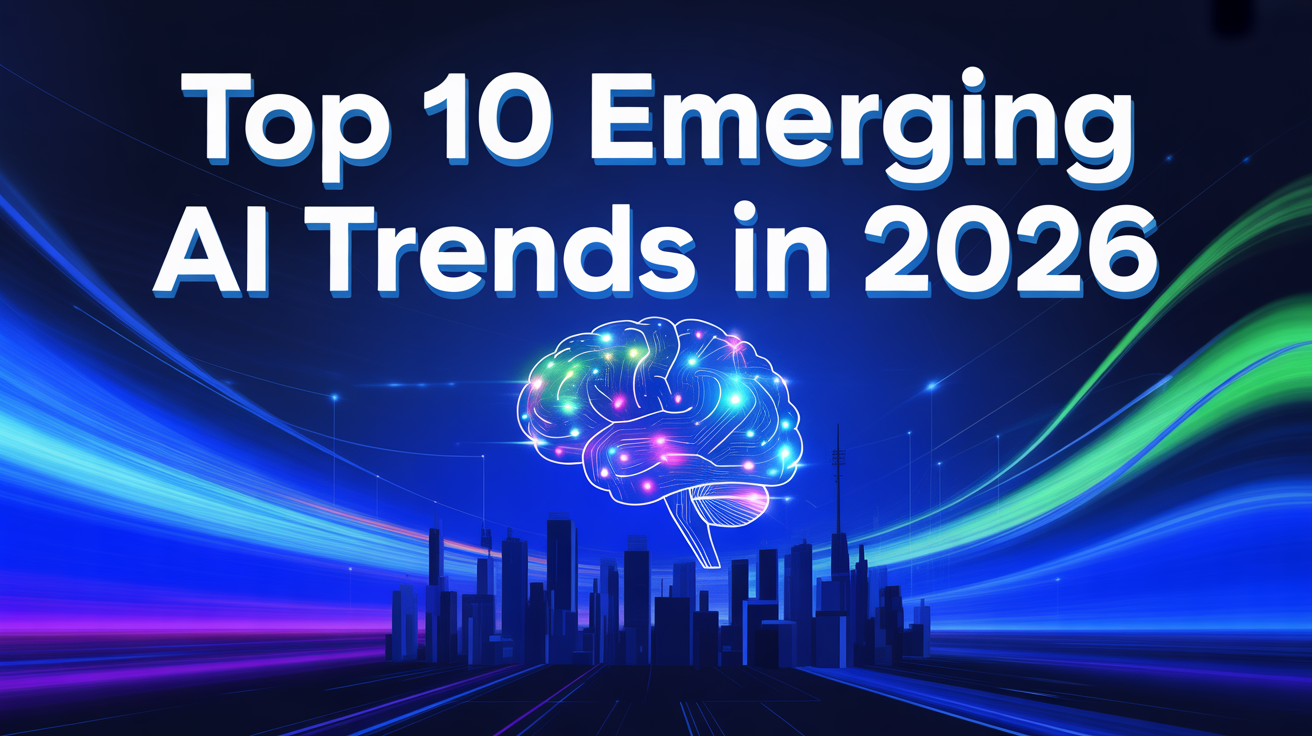
Artificial Intelligence continues to evolve at a rapid pace, and by 2026, several new trends are expected to shape how AI is developed, adopted, and integrated into daily life and business operations. These emerging AI trends are not just about more powerful algorithms, but about smarter, safer, and more practical applications that focus on real-world impact. Below are the top 10 emerging AI trends in 2026.
As AI adoption accelerates toward 2026, one of the most noticeable shifts will be how naturally AI fits into everyday digital experiences. Instead of being marketed as a separate technology, AI will operate quietly in the background, enhancing speed, accuracy, and personalization. Users may not always realize when AI is involved, but they will notice smoother interactions, smarter recommendations, and more responsive systems across platforms.
Table of Contents
Another important development is the growing focus on AI reliability. In earlier stages, AI tools were often evaluated based on novelty and performance alone. By 2026, reliability, consistency, and explainability will become just as important. Businesses will prioritize AI systems that deliver stable results over time and can be audited when needed. This shift will influence how AI models are trained, tested, and deployed in real-world environments.
AI will also play a larger role in knowledge management and decision support. Organizations are generating more data than ever, and AI will help transform this data into actionable insights. Rather than replacing human judgment, AI systems will function as advisors, highlighting patterns, risks, and opportunities that may not be immediately visible. This partnership between human expertise and machine intelligence will improve long-term planning and strategic thinking.
In consumer technology, AI personalization will move beyond basic recommendations. By 2026, AI systems will adapt in real time to user preferences, usage habits, and context. This will result in more relevant content, smarter digital assistants, and interfaces that adjust dynamically based on individual needs. Importantly, this personalization will increasingly operate within privacy-focused frameworks to maintain user trust.
Another emerging aspect of AI in 2026 is its influence on digital creativity. AI tools will support content creation by assisting with drafting, editing, visualization, and ideation. However, human creativity will remain central. AI will act as a creative partner rather than a replacement, helping creators explore ideas faster while maintaining originality and authenticity.
AI’s role in workplace learning and upskilling will also expand. Intelligent learning platforms will assess skill gaps, recommend personalized learning paths, and adapt content based on progress. This will make professional development more accessible and continuous, supporting workers as job requirements evolve.
From an economic perspective, AI will contribute to the creation of new markets and services. Startups and enterprises alike will explore AI-driven solutions tailored to specific problems, industries, and communities. This innovation will generate demand for hybrid roles that combine domain knowledge with AI awareness, reinforcing the idea that future careers will be multidisciplinary.
Finally, public perception of AI will continue to mature by 2026. As people interact with AI more frequently, understanding will replace uncertainty. Clear communication, transparent design, and responsible implementation will help build confidence in AI systems. This trust will be essential for sustainable adoption and long-term success.
Together, these developments highlight that the future of AI is not defined by a single breakthrough, but by steady, thoughtful integration into daily life. The coming years will emphasize balance, between innovation and responsibility, automation and human judgment, efficiency and ethics, shaping an AI-driven future that is practical, inclusive, and resilient.

1. AI Becomes a Core Business Infrastructure
By 2026, AI will no longer be treated as an experimental add-on. Instead, it will function as a core layer of business infrastructure, similar to cloud computing or cybersecurity. Organizations will embed AI into their workflows, decision systems, and customer-facing platforms from the ground up.
Businesses will rely on AI for forecasting, optimization, personalization, and operational efficiency. This shift will reduce manual effort and enable faster, data-informed decisions across departments. As a result, AI adoption will move from isolated tools to fully integrated enterprise systems.
2. Rise of AI Agents and Autonomous Assistants
One of the most noticeable AI trends in 2026 will be the growth of AI agents capable of handling multi-step tasks with minimal human input. These agents will go beyond basic chatbots and perform actions such as scheduling, research, report generation, and workflow coordination.
Unlike earlier automation tools, AI agents will be context-aware and capable of learning from user behavior. This will significantly improve productivity for professionals in fields such as marketing, software development, research, and operations.
Key characteristics of AI agents include:
- Ability to perform tasks across multiple tools
- Context-aware decision-making
- Continuous learning from user interactions
3. Responsible and Ethical AI Gains Priority
As AI becomes more influential, ethical considerations will move to the center of AI development. In 2026, organizations will place stronger emphasis on fairness, transparency, accountability, and data privacy.
Governments and regulatory bodies will also play a larger role in shaping AI standards. This will encourage the adoption of explainable AI systems that allow users to understand how decisions are made. Ethical AI will no longer be optional but a key requirement for trust and long-term adoption.
4. Generative AI Expands Beyond Text and Images
Generative AI will continue to evolve in 2026, expanding beyond text and image generation into more complex areas such as video, 3D modeling, simulations, and interactive content. These advancements will open new possibilities in education, entertainment, design, and product development.
Businesses will use generative AI to create prototypes, training materials, marketing assets, and personalized user experiences. The focus will shift from novelty to quality, accuracy, and practical usefulness.
5. AI-Augmented Workforces Become the Norm
Rather than replacing workers, AI in 2026 will increasingly augment human capabilities. Professionals will use AI tools to enhance productivity, reduce repetitive work, and focus on higher-value tasks.
This trend will redefine job roles across industries. Employees will be expected to collaborate with AI systems, review AI-generated outputs, and apply human judgment where needed. AI literacy will become a standard workplace skill, regardless of job title.
Examples of AI augmentation include:
- Analysts using AI for real-time insights
- Designers leveraging AI for faster iteration
- Educators using AI for personalized learning support
6. Industry-Specific AI Solutions Gain Momentum
By 2026, AI solutions will become more specialized and industry-focused. Instead of generic AI tools, organizations will adopt systems designed for specific sectors such as healthcare, finance, manufacturing, and logistics.
These tailored solutions will improve accuracy and relevance by incorporating industry-specific data and regulations. This trend will increase the effectiveness of AI while reducing the risks associated with one-size-fits-all approaches.
7. Edge AI and On-Device Intelligence Grow
Another important AI trend in 2026 is the growth of edge AI, where data processing happens directly on devices rather than relying entirely on cloud servers. This approach improves speed, reduces latency, and enhances data privacy.
Edge AI will play a crucial role in areas such as smart devices, autonomous systems, healthcare monitoring, and industrial automation. As hardware becomes more powerful, on-device AI will support real-time decision-making without constant internet connectivity.
8. AI-Powered Cybersecurity Becomes Essential
As digital threats become more sophisticated, AI-driven cybersecurity will be a critical trend in 2026. AI systems will be used to detect anomalies, predict potential attacks, and respond to threats faster than traditional methods.
Organizations will rely on AI to analyze vast amounts of security data in real time. This proactive approach will help reduce risks, protect sensitive information, and maintain trust in digital systems.
9. Integration of AI with No-Code and Low-Code Platforms
In 2026, AI will increasingly integrate with no-code and low-code platforms, allowing non-technical users to build applications and automate processes. This trend will lower barriers to innovation and empower more people to create AI-driven solutions.
By combining AI with user-friendly development tools, organizations can accelerate digital transformation without relying solely on specialized technical teams.
Benefits of this trend include:
- Faster application development
- Reduced dependency on coding expertise
- Greater participation in innovation
10. AI Governance and Compliance Roles Expand
As AI adoption increases, so does the need for structured governance. In 2026, organizations will invest more in AI governance frameworks to ensure compliance with regulations and internal policies.
This trend will lead to the growth of roles focused on AI oversight, risk management, and policy implementation. Clear governance structures will help organizations use AI responsibly while maintaining transparency and public trust.
Final Thoughts

The top 10 emerging AI trends in 2026 highlight a clear shift toward practical, responsible, and human-centered AI. Rather than focusing solely on technological breakthroughs, the emphasis will be on real-world value, ethical use, and collaboration between humans and intelligent systems.
As AI continues to mature, staying informed about these trends will be essential for professionals, businesses, and policymakers alike. Understanding where AI is heading allows individuals and organizations to adapt proactively and make smarter decisions in an increasingly AI-driven world.
Also Read: “Web3 and Decentralized Tech Explained“
FAQs
What are the most important AI trends to watch in 2026?
In 2026, key AI trends include AI-powered assistants, responsible AI practices, industry-specific AI solutions, and greater use of AI in everyday work processes. These trends focus on practical adoption rather than experimental use.
How will emerging AI trends affect businesses?
Emerging AI trends will help businesses improve efficiency, decision-making, and customer experiences. AI will increasingly support routine tasks, allowing teams to focus on strategic and creative work.
Are emerging AI trends in 2026 safe and regulated?
AI systems in 2026 are expected to follow stronger guidelines around data privacy, transparency, and ethical use. Many organizations are adopting governance frameworks to ensure AI is used responsibly and in compliance with regulations.