







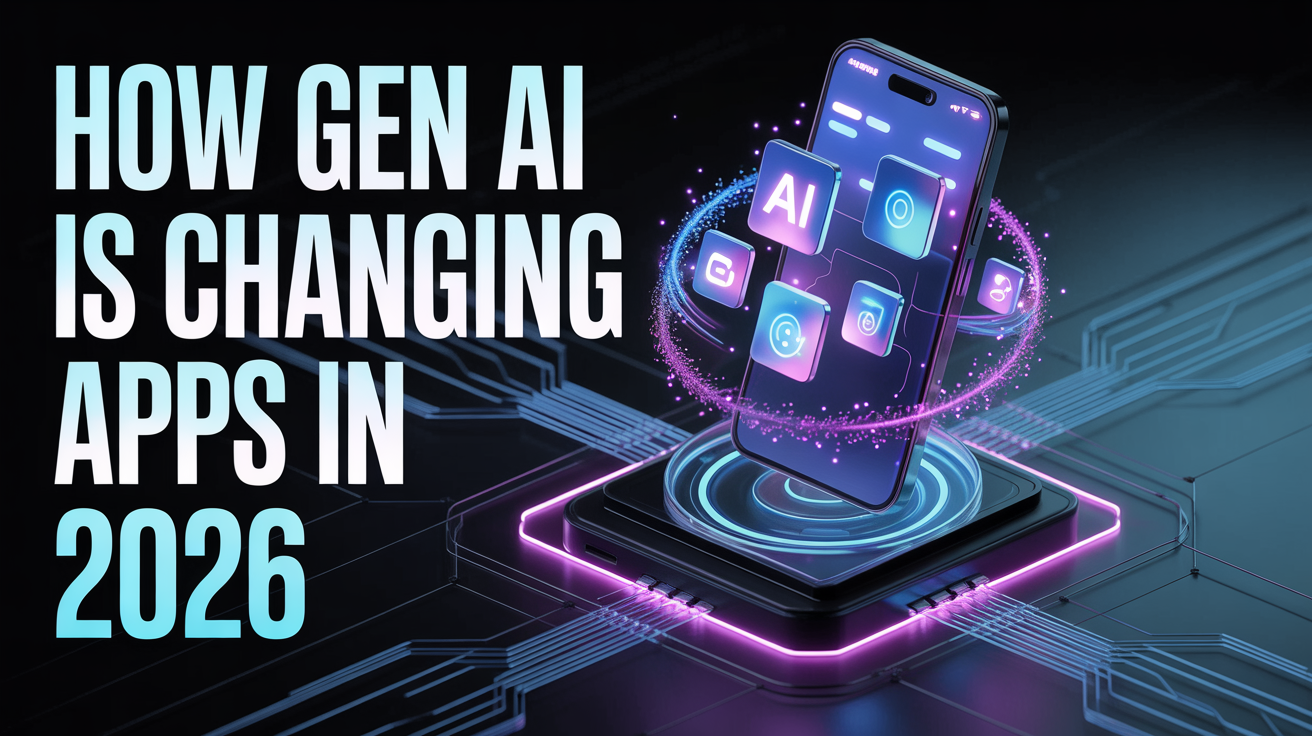
By 2026, Generative Artificial Intelligence (Gen AI) has become one of the most transformative forces in software development. What started as a niche experimental technology has now reshaped how applications are designed, built, personalized, and delivered to users. From hyper-personalized mobile experiences and intelligent automation to new interfaces and app ecosystems, Gen AI is at the center of the next wave of digital innovation. How Gen AI Is Changing Apps in 2026.
In this article, we explore how Gen AI is changing apps in 2026 the trends, technology shifts, real-world examples, challenges, and what it means for users and developers alike.
Table of Contents
The Gen AI Boom: From Optional Feature to Core Architecture
Just a few years ago, AI in apps meant adding chatbots or smart suggestions. In 2026, AI isn’t just a feature it’s part of the core architecture of modern applications.
According to industry forecasts, over 70% of apps especially enterprise and consumer-focused ones, will include AI-driven agents or features by 2026. This shift is driven not by novelty, but by user expectations for smarter, quicker, and more intuitive digital experiences.
From AI-Added to AI-Native
Earlier app development treated AI as an “add-on.” In 2026, many developers follow an AI-first development mindset. This means:
- Designing app workflows around intelligent insights
- Hardwiring generative models into user interactions
- Building systems that continuously learn from user behavior
This change boosts user retention, increases engagement, and makes apps more adaptive overall.
Intelligent and Personalized User Experiences
One of the most visible impacts of Gen AI is the hyper-personalization of app experiences.
Traditional apps serve the same content and layout to all users. Gen AI, however, creates experiences that adapt in real time based on:
- User behavior
- Intents and preferences
- Context like location, time of day, and historical usage patterns
For example:
- Recommendation feeds in social, e-commerce, or media apps now feel tailor-made for each individual.
- Navigation menus rearrange dynamically based on user habits.
- AI can offer real-time predictive suggestions like prompting next steps in a task without user input.
This level of personalization drives higher conversion rates and deeper user satisfaction.
Natural Language Interaction and Conversational Interfaces
Gen AI models have drastically improved natural language understanding, enabling conversational user interfaces (CUIs) where spoken or written language becomes the primary way to interact with apps.
Now, users can:
- Ask an app what they want in everyday language
- Request complex tasks like scheduling, summarizing, booking or editing
- Interact with voice-led workflows as easily as chatting with a human
Apps with sophisticated language models are no longer limited to simple “voice commands” they can understand context-rich requests, support multiple languages, and generate meaningful responses.
This shift lowers barriers for users, especially in multilingual markets or accessibility-focused applications.
Accelerated Development and Testing
For developers, the influence of Gen AI is equally profound.
AI-Driven Code Generation
Developers now use AI to produce functional code based on simple natural language prompts. Gen AI tools automatically generate:
- UI layouts
- Backend logic
- Data models
- Test scripts
This significantly cuts development time, reduces repetitive work, and enables smaller teams to ship complex applications faster than ever before.
Smarter QA Testing
Instead of manual testing or traditional automation, Gen AI now generates exhaustive test cases, simulates edge-case conditions, and predicts vulnerabilities before deployment, making apps more stable and resilient.
On-Device AI and Privacy-Aware Computing
Another major trend is on-device AI processing, especially in mobile and wearable apps. This approach:
- Improves performance by reducing network dependency
- Enhances data privacy since sensitive information stays on device
- Enables real-time responses even offline
In 2026, a significant portion of AI workloads especially those involving personalization or voice recognition runs locally on devices to reduce latency and protect user data.
Multimodal Interaction and Immersive UIs
Gen AI’s impact goes beyond text and speech apps are now truly multimodal, capable of handling:
- Text
- Voice
- Images
- Gesture and context recognition
- Even AR/VR augmented experiences
For example, apps can now:
- Summarize videos
- Understand images within chats
- Translate signs in real time using camera input
- Respond to natural gestures and eye gaze
This convergence of modalities makes digital interactions richer and more intuitive, blurring boundaries between physical and digital experiences.
New Ecosystems and App Distribution Models
Gen AI is also changing how apps are distributed and consumed. Large AI platforms like ChatGPT and Google’s Gemini now host “AI-centric app experiences” where apps are embedded inside conversational AI hubs.
Instead of requiring a standalone install, many app functions can be accessed through AI agents increasing reach and lowering user friction
This raises new opportunities for developers to tap into massive AI audiences rather than competing solely in app stores.
Challenges and Ethical Considerations
Despite its benefits, Gen AI’s integration into apps also brings challenges:
Bias and Fairness
AI models can inadvertently reinforce harmful biases if not trained and audited responsibly.
Data Privacy
With deeper personalization comes the need for robust data governance and compliance with regulations around user data.
Transparency & Trust
Users expect clear explanations about what AI is doing and why. Without explainable AI, trust can erode.
Smart developers are investing heavily in ethical AI practices, explainability, security, and privacy safeguards not just innovation.
Future Outlook: 2027 and Beyond
Looking ahead, Gen AI will continue to evolve:
- Autonomous AI agents that run entire workflows
- Fully conversational OS experiences
- Deep integration into wearables, AR/VR, and real-world devices
- Predictive, context-aware digital ecosystems
These advancements will push apps closer to anticipation rather than reaction meaning software won’t just respond to user requests, but predict and fulfill them before users even ask.
Also Read: “The Race for Quantum Chips in 2026“
FAQs | How Gen AI Is Changing Apps in 2026
Q1: What is Generative AI in the context of apps?
Generative AI refers to AI systems capable of creating content text, images, code, and interactions that are increasingly integrated into applications to personalize experiences and automate tasks.
Q2: How does Gen AI change user experiences?
Gen AI enables apps to personalize interfaces, anticipate user needs, and offer natural language interactions that feel conversational and intuitive.
Q3: Are apps becoming fully autonomous with AI?
Yes, many apps now include autonomous AI agents that can perform complex tasks such as scheduling, content generation, and system optimization with minimal human input.
Q4: Does Gen AI make apps more secure?
AI can improve security by identifying vulnerabilities and generating safer code, but it also introduces new risks that require careful governance and safeguards.
Q5: What industries benefit the most from Gen AI apps?
Practically every industry from healthcare and finance to gaming and education benefits from AI-enhanced apps through personalization, automation, and smarter insights.