







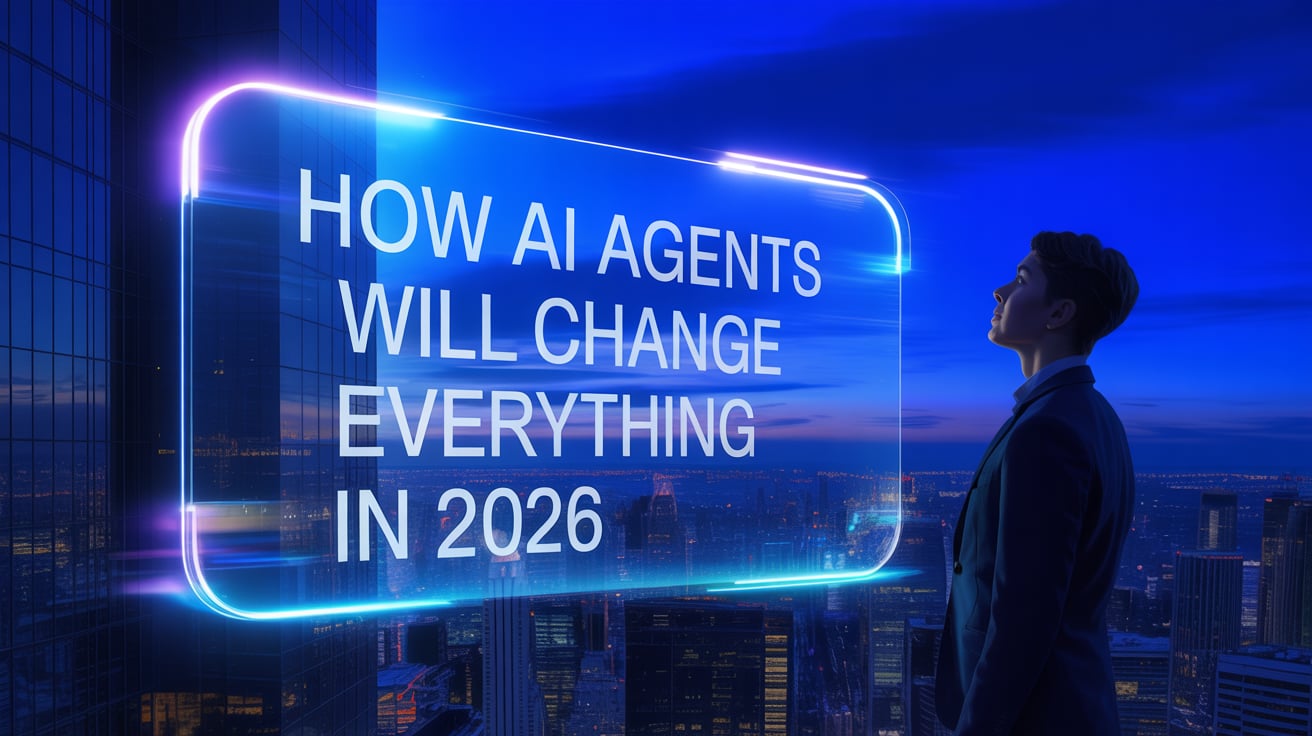
As we approach 2026, we stand on the cusp of a technological transformation one that doesn’t involve a new phone, a faster chip, or a cooler app. Instead, it centers on autonomous digital workers: AI agents, intelligent, goal-oriented software systems that plan, act, and collaborate largely on their own. This shift could reshape how we work, build, buy, protect, and live. How AI Agents Will Change Everything in 2026.
Table of Contents
What Are AI Agents, And Why They Matter
At its simplest, an “AI agent” is more than a chatbot. Rather than waiting for a user to type a prompt and responding, agents can take initiative, plan multi-step tasks, use tools, and make decisions sometimes without further human input.
Key traits that distinguish AI agents from traditional software or simple chatbots:
- Goal-oriented & autonomous planning: you specify a goal, the agent figures out how to get there, possibly breaking tasks into subtasks.
- Tool usage & integration: agents can call APIs, fetch data, run code, manage files or external systems, not just produce text.
- Memory and context awareness: they remember past interactions or data, enabling long-term workflows or multi-step projects.
- Multi-agent collaboration: multiple agents can coordinate, each specialized in sub-tasks, working like a small team
Rather than just tools, AI agents are fast becoming digital employees: ever-awake, ever-available, and able to scale far beyond human limits.
The 2026 Turning Point: What’s Different
2026 isn’t just another year it’s a tipping point when agentic AI begins to permeate software, business, and infrastructure at scale. Here’s what is changing:
- The Interface Shift, From Apps to Agents
Software usage is evolving. Instead of opening apps and clicking menus, users will increasingly rely on agents: you provide intent or high-level instructions, and agents decide which tools to use, how to execute, and deliver results automatically.
In many cases, the “app” becomes invisible replaced by an agent that just works for you.
- Businesses Will Look More Like Agent-Powered Entities
Startups and enterprises will increasingly restructure around autonomous agents. According to some predictions, a single human founder could manage a full business with 20+ agents handling operations, marketing, development, customer support, and more.
Some organizations may run entire departments with almost zero human staff. This “agent workforce” can operate 24/7, scale instantly, and drastically reduce costs.
- Agents Everywhere, From Back-Office to Customer-Facing Roles
Starting from 2026, AI agents will permeate nearly all domains:
| Domain | What Agents Could Do |
|---|---|
| Business Operations | Automate workflows, scheduling, supply-chain decisions, financial transactions, reporting, and resource optimization. |
| Customer Support & Sales | Manage customer queries, personalize engagement, automate lead generation and follow-up, even close deals autonomously. |
| Software & Product Development | Write and test code, deploy products, run QA, manage releases, effectively acting as autonomous development teams. |
| Cybersecurity & Risk Mitigation | Monitor threats, detect suspicious activity, autonomously respond to breaches or anomalies in real time. |
| Creative/Knowledge Work | Research, content generation, data analysis, legal research, contract review, document drafting with higher speed and lower cost. |
In short almost any task that is repeatable, data-driven or process-driven could become agent-automated.
- Infrastructure Will Evolve: From Cloud to Distributed Agentic Systems
Recent research indicates that as agentic AI grows, so will changes to computing infrastructure: edge computing, decentralized architectures, and on-premises systems may replace monolithic cloud reliance. This is because agentic AI often needs efficient resource use, lower latency, and more control over privacy and governance.
We may see emergence of “agent infrastructure” shared protocols, identity frameworks, audit logs, and standardized governance mechanisms to manage, monitor, and regulate agents operating across ecosystems.
Opportunities & Benefits: What We Stand to Gain
- Massive Productivity Gains: Tasks that take hours or days could be done in minutes. Agents don’t sleep or take breaks, and can scale instantly.
- Cost Efficiency: By automating repetitive or routine jobs, companies can reduce workforce costs by up to 40–50% in those areas without sacrificing quality.
- Access to Skill at Scale: Small businesses or individuals may get access to “AI-driven teams”: marketing, development, customer support, operations things once possible only for big companies.
- Innovation Speed: Faster iteration, prototyping, deployment. Agents can test, learn, pivot reducing time to market dramatically.
- Continuous Availability: 24/7 operations customer support at any hour, global servicing, non-stop monitoring.
In many ways, AI agents could democratize capabilities leveling the playing field between small startups and big corporations.
How AI Agents Will Change Everything in 2026
Challenges & Risks: What Could Go Wrong
- Governance & Accountability: When agents act autonomously making decisions, executing transactions who is responsible if something goes wrong? Recent research advocates building agent infrastructure to track, attribute, and audit actions.
- Reliability & Safety: Agents may plan poorly, make mistakes, or behave unpredictably especially in complex, ambiguous situations. As one expert review argues, we should aim for human-agent collaboration systems, not full autonomy, to maintain safety and quality.
- Security Risks: Autonomous agents may become new vectors for cyber-attacks or misuse, especially if compromised or poorly designed.
- Job Displacement & Ethical Concerns: As agents take over tasks, many jobs may become redundant raising questions about workforce transition, inequality, and societal impact.
- Infrastructure & Integration Complexity: Legacy systems, data silos, regulatory constraints, privacy migrating to agentic workflows will require investment, governance and often major overhauls.
What 2026 May Look Like: A Glimpse into a Near Future
- Many businesses from small startups to large enterprises will operate large parts of their workflows with agent teams, working around the clock.
- We’ll increasingly hear about “agentic OSes” and “agent-powered platforms”: software where the UI is minimal and the real work happens via agents behind the scene.
- Entrepreneurship will get easier. A solo founder might launch a fully functional e-commerce store, manage marketing, customer support, logistics all using agents.
- Governments and regulatory bodies may start rolling out frameworks for AI-agent governance, accountability, and auditing.
- Innovation cycles will accelerate but so will the need for robust safety, security, and ethical guardrails.
In short: 2026 could mark the moment when AI agents shift from “interesting tech” to the backbone of industry, commerce, and daily life.
Conclusion
The rise of AI agents isn’t a minor upgrade. It’s a paradigm shift in how we think of software, work, businesses, and even the structure of the economy. 2026 might be remembered as the year when we stopped launching apps, and started deploying autonomous digital workforces.
That future brings immense promise: productivity leaps, cost efficiency, faster innovation, and democratized access to high-end capabilities. But it also calls for vigilance: governance, ethics, safety, fairness, and accountability will be just as critical as the technology itself.
If you’re a business leader, developer, entrepreneur or just someone curious about what’s next now is the time to understand, prepare for, and shape the agent-powered world that’s coming.
Also Read: “The Rise of Autonomous AI in 2026“
FAQ’s
Q: Are AI agents just smarter chatbots?
A: No. While chatbots respond to prompts, AI agents plan, act, and execute tasks, often autonomously, involving multiple steps, using tools, and incorporating memory/context.
Q: Will AI agents replace human workers entirely?
A: Not necessarily. In many cases, agents will handle repetitive, routine, or data-heavy tasks, freeing humans to focus on creativity, strategy, empathy, and oversight. But some roles may indeed become redundant.
Q: How safe is it to let AI agents act on their own?
A: There are risks: poor decisions, security vulnerabilities, lack of accountability. That’s why many experts recommend combining autonomy with strong governance, human oversight, and agent infrastructure (audit logs, identity, transparent protocols).
Q: What kinds of businesses will benefit most from AI agents?
A: Businesses with repetitive workflows, heavy data tasks, customer interaction, or high operational complexity, e.g. logistics, e-commerce, legal, finance, software, customer support, supply chain, stand to gain the most.
Q: When will AI agents become mainstream?
A: Many technologists and analysts predict 2025–2026 as the inflection point, when agentic AI moves from early adopters to widespread enterprise and even consumer use.