








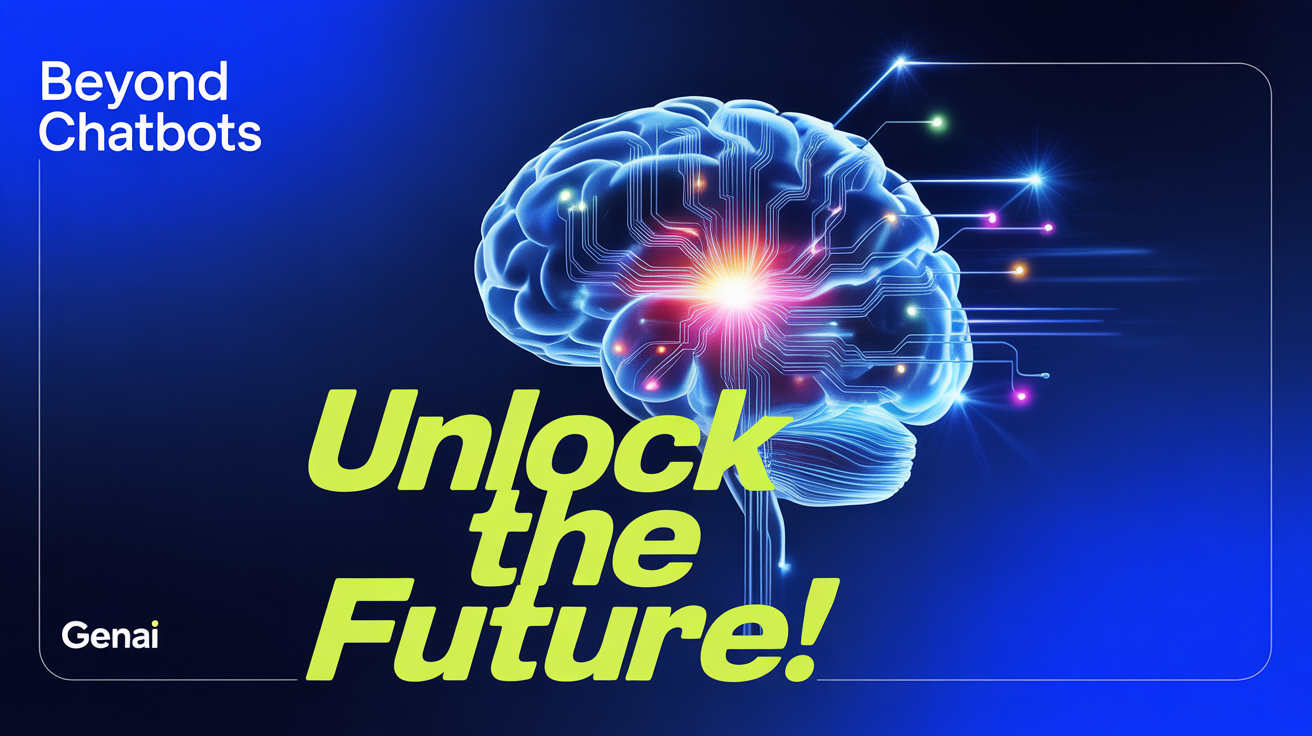
For many people, generative AI became real the moment they chatted with a bot that could write emails, answer questions, or generate poems in seconds. Chatbots were the public entry point, but they are only the surface layer of a much deeper transformation. Generative AI, often called GenAI, is rapidly moving beyond conversational interfaces and embedding itself into the core of software, products, and business operations. GenAI Beyond Chatbots.
Today, GenAI designs software, creates marketing assets, simulates supply chains, accelerates drug discovery, automates customer operations, and reshapes how decisions are made at scale. In many cases, users never interact with a chatbot at all. The intelligence operates quietly in the background, generating outcomes rather than conversations.
This article explores how GenAI is evolving beyond chatbots, where it is already delivering real-world value, how businesses are deploying it responsibly, and why this shift represents a fundamental change in how digital systems are built and used.
Table of Contents
Understanding Generative AI Beyond Conversations
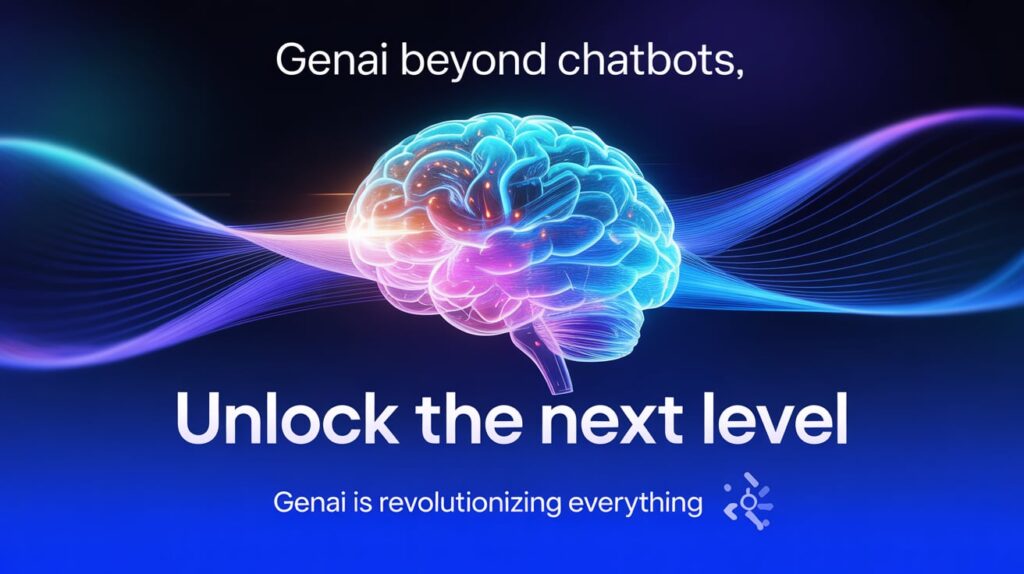
Generative AI refers to models that can create new content, code, designs, images, audio, video, and even strategies based on patterns learned from vast datasets. While chatbots present this capability through natural language interaction, the underlying models are far more versatile.
When GenAI operates beyond chatbots, it becomes:
• A decision engine rather than a dialogue system
• A creative layer inside workflows
• An automation driver embedded in products
• A simulation tool for complex systems
In this form, GenAI focuses less on talking and more on doing.
Why Chatbots Were Only the Beginning
Chatbots gained popularity because they were easy to understand and demo. A conversation feels intuitive. However, businesses quickly realized that value increases dramatically when generative models are integrated directly into workflows.
Instead of asking a chatbot to summarize a report, companies want reports generated automatically. Instead of chatting about code, they want code written, tested, and deployed. Instead of discussing marketing ideas, they want campaigns created and optimized continuously.
This shift moves GenAI from a front-end experience to a back-end capability.
GenAI in Software Development and Engineering
One of the fastest-growing areas beyond chatbots is software engineering. GenAI now plays an active role throughout the software lifecycle.
It generates code, refactors legacy systems, writes tests, creates documentation, and reviews pull requests. Developers increasingly describe what they want rather than manually writing every line.
Platforms influenced by research from OpenAI and integrated into tools by Microsoft have turned GenAI into a daily productivity layer for developers.
Beyond productivity, GenAI is reshaping architecture decisions. Models can suggest design patterns, identify performance bottlenecks, and simulate system behavior under different loads, making software more resilient and scalable.
GenAI in Design, Media, and Creative Production
Creative work is no longer limited to text-based chat outputs. GenAI systems now generate images, videos, music, animations, and interactive experiences.
Design teams use GenAI to produce multiple design variations instantly, speeding up ideation and experimentation. Video teams generate storyboards, voiceovers, and even rough cuts automatically. Music and sound design workflows are enhanced by AI-generated compositions tailored to mood and context.
For brands, this means faster content cycles and personalization at scale. For creators, it means more time spent refining ideas rather than producing raw assets.
GenAI in Marketing and Growth Systems
Modern marketing is data-heavy and fast-moving. GenAI thrives in this environment.
Instead of manually crafting every campaign, GenAI systems generate ad copy, landing pages, email sequences, and social media content automatically. These systems test variations continuously, learn from performance data, and optimize messaging without human intervention.
GenAI also personalizes content in real time, adapting tone, visuals, and offers based on user behavior. This moves marketing from static campaigns to living systems that evolve constantly.
GenAI in Customer Operations Without Chatbots
Customer support is often associated with chatbots, but GenAI is now used far beyond chat interfaces.
It analyzes support tickets, predicts issues before they occur, auto-generates responses for agents, and updates knowledge bases automatically. In many cases, customers never interact with an AI directly, but benefit from faster resolution and more accurate support.
GenAI also identifies product issues by analyzing feedback at scale, helping companies fix problems before they escalate.
GenAI in Healthcare and Life Sciences
Healthcare is one of the most impactful areas for GenAI beyond chatbots.
GenAI models analyze medical images, generate clinical notes, assist in diagnosis, and simulate treatment outcomes. In drug discovery, they generate molecular structures, predict interactions, and dramatically reduce research timelines.
Instead of replacing doctors or researchers, GenAI augments expertise by handling complexity and scale that humans cannot manage alone.
Because healthcare is highly regulated, GenAI systems here are often embedded quietly into tools rather than exposed directly to patients.
GenAI in Finance, Risk, and Decision Systems
Financial institutions use GenAI for far more than customer chat.
GenAI models generate risk assessments, simulate market scenarios, detect fraud patterns, and automate compliance reporting. These systems analyze massive datasets in real time and produce insights that guide decisions instantly.
Investment firms use GenAI to test strategies across thousands of simulated market conditions. Banks use it to monitor transactions and flag anomalies autonomously.
In finance, GenAI operates as an invisible analyst working continuously.
GenAI in Manufacturing and Industrial Operations
In industrial settings, GenAI is embedded into control systems, planning tools, and optimization engines.
It generates production schedules, predicts equipment failures, and optimizes supply chains. Digital twins powered by GenAI simulate factories, helping teams test changes before implementing them in the real world.
Companies like Siemens are using generative models to accelerate industrial design and operational efficiency.
This application of GenAI reduces downtime, lowers costs, and increases flexibility in complex environments.
GenAI in Data Analysis and Business Intelligence
Traditional analytics tools rely on predefined dashboards and queries. GenAI changes this by generating insights dynamically.
Instead of asking fixed questions, businesses receive automatically generated reports, trend explanations, and forecasts. GenAI can identify patterns humans might miss and present them in understandable formats.
This shifts analytics from reactive reporting to proactive intelligence.
GenAI and Autonomous Systems
Beyond chatbots, GenAI increasingly powers autonomous systems.
These include self-optimizing cloud infrastructure, automated trading platforms, cybersecurity defense systems, and logistics networks. GenAI models generate strategies, evaluate outcomes, and adjust behavior continuously.
Humans set goals and constraints. GenAI executes and optimizes within those boundaries.
How GenAI Is Embedded Into Products
GenAI beyond chatbots typically follows a structured integration model.
| Layer | Role of GenAI |
|---|---|
| Input | Interprets data from users, sensors, or systems |
| Generation | Creates content, code, designs, or decisions |
| Execution | Feeds outputs directly into workflows |
| Feedback | Learns from results to improve performance |
This architecture allows GenAI to function as a system component rather than a user-facing tool.
Why Businesses Are Moving Beyond Chatbots
Chatbots are useful, but they create friction. Users must ask questions and interpret answers.
By embedding GenAI directly into workflows, businesses eliminate that friction. Work happens automatically. Insights appear when needed. Actions are taken without prompts.
This is why the most valuable GenAI applications are often invisible.
Challenges of GenAI Beyond Chatbots
Despite its promise, GenAI beyond chatbots introduces challenges.
Models can hallucinate or generate incorrect outputs. Bias in training data can affect decisions. Integration complexity increases as GenAI touches critical systems.
There are also governance concerns. When AI generates outcomes without direct human interaction, accountability and transparency become essential.
Responsible deployment requires monitoring, validation, and human oversight.
Ethical and Regulatory Considerations
As GenAI becomes more autonomous, ethical questions grow more complex.
Who is responsible for AI-generated decisions. How do organizations ensure fairness. How is sensitive data protected.
Regulators are beginning to address these questions, especially in healthcare, finance, and critical infrastructure. Businesses adopting GenAI must prioritize trust, explainability, and compliance.
Skills Shift in a GenAI-Driven World
As GenAI moves beyond chatbots, skills requirements change.
Prompting becomes less important than system thinking. Understanding workflows, data quality, and outcomes matters more than interacting with a chatbot.
Roles evolve from operators to designers, supervisors, and strategists of AI-driven systems.
The Future of GenAI Beyond Interfaces
The future of GenAI is not conversational. It is contextual, autonomous, and embedded.
Users will not ask AI to help. Help will arrive automatically. Systems will anticipate needs, generate solutions, and execute actions seamlessly.
Chatbots will remain useful, but they will represent only a small fraction of GenAI’s real impact.
Final Thoughts
GenAI beyond chatbots marks a turning point in how technology creates value. The biggest gains come not from talking to AI, but from letting it work quietly inside products, workflows, and systems.
As GenAI shifts from interfaces to infrastructure, it becomes less visible but far more powerful. Businesses that understand this transition will move faster, operate smarter, and unlock new levels of efficiency and creativity.
Chatbots showed the world what generative AI could do. What comes next will redefine how work itself gets done.
Also Read: “How AI Helps Small Businesses in 2026“
FAQs
Q1: Is GenAI just an advanced chatbot?
A: No. While chatbots are popular GenAI applications, the technology extends to content generation, automation, simulations, synthetic data, and decision support systems across industries.
Q2: What industries benefit most from GenAI today?
A: Healthcare, finance, education, architecture, and enterprise automation are among the leading sectors leveraging GenAI beyond chat.
Q3: How does GenAI enhance enterprise operations?
A: Through workflow automation, intelligent task execution, document generation, and data synthesis that reduce manual workloads and errors.
Q4: Are there risks with GenAI?
A: Yes. Model hallucinations, privacy concerns, and bias are major risks that require active mitigation.
Q5: What’s next for GenAI technologies?
A: Expect deeper integration into core systems, multimodal creative engines, predictive analytics, and autonomous agents that collaborate with humans.