










Introduction, The Biometric Collapse in the Era of Deepfake Presentation Attacks
At Ninth Post, we recently attempted to bypass a standard 2D facial scanner using a commercially available real-time deepfake pipeline. The tools required were not exotic. A consumer GPU, an open-source generative model, and approximately fifty dollars worth of software subscriptions were enough to produce a convincing facial stream capable of mimicking a target user. Biometric Security in the Age of Deepfakes: Testing Heart-Rate ID and Vein Pattern Authentication.
The attack succeeded in under ten seconds.
That experiment illustrates a reality security researchers have been warning about for several years. The rapid advancement of generative AI has fundamentally altered the threat model for biometric authentication systems. The sensors that once seemed futuristic, facial recognition cameras, voice authentication, and even fingerprint scanners, were designed for a world where reproducing human identity was technically difficult.
In 2026, that assumption no longer holds.
Generative models can now synthesize photorealistic faces, clone voices with minimal training data, and inject these signals directly into digital authentication pipelines. This category of attacks is now widely known as Deepfake Presentation Attacks, where artificial identity signals are presented to biometric systems in real time.
The implications are serious.
Most consumer devices today rely on external biometrics, characteristics that are visible or accessible on the surface of the body. These include:
- facial geometry
- voice patterns
- fingerprints
Unfortunately, these identifiers share a common vulnerability. They can all be replicated or intercepted.
Faces can be recreated with deepfake models. Voices can be cloned from short audio samples. Fingerprints can be lifted from surfaces and reproduced using conductive materials.
This is why the security community is shifting its attention toward internal biometrics.
Rather than identifying the external appearance of a person, these systems verify physiological processes that occur inside the human body. These signals are far more difficult to reproduce artificially because they require active biological systems.
Two technologies are emerging as the most promising candidates:
- Heart-Rate Authentication, based on electrical cardiac signatures
- Vascular Biometrics, based on near-infrared mapping of blood vessels
These approaches do not simply identify a person.
They verify that a living human body is present.
Table of Contents
The Physics of Unfakeable ID
The fundamental principle behind internal biometric systems is that biological processes produce signals that are extremely difficult to simulate convincingly.
These signals originate from living tissue, circulating blood, and electrical activity within the body.
When measured correctly, they create a dynamic identity signature that changes constantly but remains statistically unique to each individual.
Heart-Rate Authentication, The ECG Signature
One of the most promising forms of internal biometric authentication is ECG Signature Analysis.
The human heart produces electrical signals every time it contracts. These signals propagate through the body and can be detected by sensors placed on the skin.
The waveform produced during each heartbeat is commonly known as the PQRST complex.
This waveform includes several distinct components:
- P wave, representing atrial depolarization
- QRS complex, representing ventricular contraction
- T wave, representing ventricular repolarization
The exact shape, amplitude, and timing of these waves vary slightly between individuals due to differences in heart anatomy and electrical conduction pathways.
These variations create a biometric pattern.
Unlike fingerprints or facial features, ECG signatures are dynamic. They fluctuate based on physiological conditions but maintain consistent structural characteristics unique to each person.
This makes them extremely difficult to replicate.
A deepfake video can reproduce the appearance of a face. But generating a realistic ECG waveform synchronized with a live human body requires access to internal physiological signals.
That is a far more complex challenge.
Photoplethysmography and Pulse Signatures
Another related technology used in Heart-Rate Authentication is Photoplethysmography, commonly abbreviated as PPG.
PPG sensors measure tiny changes in blood volume beneath the skin using optical light.
A typical PPG sensor works by emitting light into the skin and measuring the amount of light reflected back. Because blood absorbs light differently than surrounding tissue, each heartbeat produces a subtle change in the reflected signal.
This allows the sensor to detect:
- pulse rate
- blood flow patterns
- microvascular dynamics
In advanced implementations, these pulse waveforms can be analyzed to create a biometric signature.
However, this technology also introduces potential attack surfaces known as Photoplethysmography Spoofing.
Attackers may attempt to simulate pulse signals using modulated light sources or mechanical vibration. For this reason, modern systems combine PPG with other physiological signals to verify authenticity.
Vein Pattern Recognition
While heart signals verify internal electrical activity, Vascular Biometrics focus on the structure of the circulatory system.
Inside the human hand lies a dense network of blood vessels that form unique patterns beneath the skin. These patterns remain stable throughout adulthood and are extremely difficult to replicate.
Unlike fingerprints, vein patterns are internal.
They cannot be photographed easily, nor can they be left behind on surfaces.
To capture these patterns, sensors use Near-Infrared (NIR) Vascular Mapping.
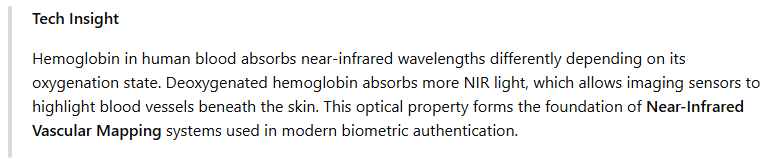
Near-infrared light penetrates human skin and is absorbed by hemoglobin in the blood. When illuminated with NIR light, blood vessels appear as dark lines because they absorb more light than surrounding tissue.
This allows imaging sensors to capture detailed maps of the vascular network inside the palm or finger.
These maps form a biometric template that can be used for authentication.
Tech Insight, Near-Infrared Absorption by Deoxygenated Hemoglobin

The Ninth Post Red Team Test
At Ninth Post, we conducted a simulated lab test to evaluate the effectiveness of internal biometrics compared with traditional facial authentication systems.
The test environment consisted of two authentication devices:
- A standard facial recognition system similar to those used in consumer smartphones.
- A palm vein authentication scanner using Near-Infrared Vascular Mapping.
The attack scenario involved injecting a real-time deepfake stream into the camera pipeline.
The deepfake system generated a high-resolution facial video of the target user, synchronized with realistic head movement and lighting conditions.
Facial Recognition Result
The facial authentication system successfully matched the deepfake identity in several test attempts.
Although modern systems include some Presentation Attack Detection (PAD) mechanisms, they primarily rely on visual cues such as blinking or head movement.
Advanced deepfake models can now simulate these behaviors convincingly.
As a result, the facial scanner accepted the synthetic identity.
Palm Vein Authentication Result
When the same attack was attempted against the palm vein scanner, the outcome was different.
The scanner required a valid vascular map and active blood flow to authenticate the user.
The deepfake injection could reproduce the appearance of the user’s hand but could not reproduce the internal vascular pattern or the dynamic absorption characteristics of living blood.
Without real blood flow, the system rejected the authentication attempt.
This illustrates one of the core advantages of Vascular Biometrics.
The biometric signature is not visible externally and requires a living circulatory system to generate valid sensor readings.
Technical Deep-Dive, Liveness Detection 2.0
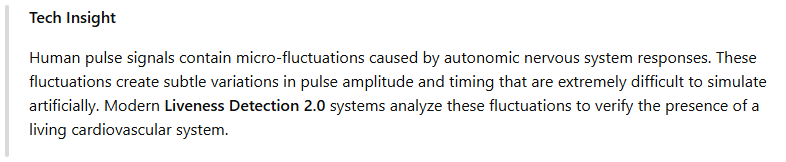
Modern biometric systems are increasingly adopting a concept known as Liveness Detection 2.0.
Traditional biometric systems relied primarily on static matching.
For example, a fingerprint scanner compares ridge patterns with stored templates.
But static matching is vulnerable to spoofing because attackers can replicate physical patterns.
Liveness detection introduces physiological verification.
Instead of asking “Does this pattern match the stored template?” the system asks a deeper question:
Is a living human body generating this signal?
To answer this, modern sensors measure multiple physiological signals simultaneously.
These may include:
- pulse waveform fluctuations
- blood oxygen saturation (SpO2)
- microvascular blood flow dynamics
- thermal signatures
By combining these signals, authentication systems can verify that the biometric input originates from a living human rather than a synthetic replica.
Comparative Analysis of Modern Biometric Systems
The differences between traditional and emerging biometric systems become clearer when comparing their technical characteristics.
| Biometric Method | Spoof Resistance (1-10) | Hardware Cost | User Friction | Environmental Sensitivity |
|---|---|---|---|---|
| Face ID (Legacy) | 4 | Low | Very Low | Sensitive to lighting |
| Fingerprint | 5 | Low | Low | Affected by moisture or dirt |
| Heart-Rate (ECG) | 9 | Medium | Moderate | Sensitive to electrode placement |
| Vein Pattern | 9 | Medium-High | Low | Cold weather may reduce vein visibility |
This comparison highlights an important trend.
Internal biometric systems provide significantly higher resistance to spoofing attacks compared with traditional methods.
However, they often require more specialized hardware.
Continuous Authentication and Passive Persistent ID
Beyond improving login security, internal biometrics also enable a new concept known as continuous authentication.
Traditional authentication occurs at a single moment.
A user unlocks a device and gains access until the session ends.
But what happens if the device is stolen after it is unlocked?
Continuous authentication addresses this problem by verifying identity continuously during device usage.
One emerging model involves Passive Persistent ID.
In this system, wearable devices such as smartwatches measure Heart-Rate Authentication signals continuously.
As long as the device detects the correct cardiac signature nearby, connected devices remain unlocked.
If the signature disappears, indicating that the user has moved away, the system locks automatically.
This approach transforms authentication from a one-time event into a continuous verification process.
The Privacy Paradox
While internal biometrics provide stronger security, they also introduce new privacy concerns.
Biometric data derived from internal physiology is extremely sensitive.
A cardiac signature or vascular map cannot be changed if compromised.
This raises a critical question:
How can systems store and verify such data without exposing it to risk?
One promising solution involves Zero-Knowledge Proofs (ZKP).
Rather than storing the biometric data directly, the system stores cryptographic proofs derived from that data.
When a user authenticates, the device proves that the biometric signal matches the stored proof without revealing the original biometric information.
This allows authentication systems to verify identity while minimizing exposure of sensitive physiological data.
Tech Insight, Micro-Fluctuation Pulse Analysis

The Future of Non-Contact Biometric Sensors
The next generation of authentication systems will likely rely heavily on Non-Contact Biometric Sensors.
Advances in optical sensing and radar-based biosignal detection are enabling systems that can measure heart rate and vascular patterns without physical contact.
These sensors use technologies such as:
- remote photoplethysmography
- millimeter-wave radar
- optical blood flow imaging
Such systems may eventually allow devices to authenticate users simply by detecting physiological signals within proximity.
This would eliminate the need for deliberate authentication gestures entirely.
Final Verdict, The Internal Biometric Era
At Ninth Post, our investigation into Deepfake Presentation Attacks reveals a clear conclusion.
External biometrics are rapidly losing their reliability.
Faces can be synthesized. Voices can be cloned. Fingerprints can be replicated.
But internal physiological signals remain far more difficult to fake convincingly.
Technologies such as Heart-Rate Authentication, Vascular Biometrics, and advanced Liveness Detection 2.0 systems represent the next generation of identity verification.
They shift the focus from appearance to biology.
From static patterns to dynamic physiological processes.
The result is a new security paradigm where identity is verified not by how a person looks, but by how their body functions.
The external biometric era is ending.
The internal era has just begun.
The Sensor Arms Race Between Attackers and Defenders
As with every major security breakthrough, the rise of Vascular Biometrics and Heart-Rate Authentication is triggering a new technological arms race between attackers and defenders. Historically, biometric security systems have followed a predictable lifecycle. When a new biometric modality appears, it initially offers strong resistance to spoofing attacks. Over time, adversaries study the system and attempt to replicate the signals it measures.
However, internal biometrics present a unique challenge for attackers because the signals originate from living physiological systems rather than static physical characteristics. This dramatically increases the complexity of successful spoofing attempts.
To simulate a vascular biometric signature, an attacker would need to recreate several simultaneous biological conditions. These include the correct vein geometry, real-time blood flow dynamics, appropriate hemoglobin absorption characteristics, and subtle thermal variations associated with circulating blood. Even if an attacker could replicate the visual structure of the vascular network, the absence of real-time physiological responses would likely trigger modern Presentation Attack Detection (PAD) systems.
Security researchers are already exploring hypothetical attack models involving artificial blood-flow simulators and synthetic tissue materials designed to mimic optical absorption patterns. But these approaches remain largely experimental and impractical outside highly controlled laboratory environments.
In practical terms, this means the barrier to entry for biometric spoofing has increased dramatically. While deepfake software can be downloaded by almost anyone, constructing a physiological signal simulator capable of passing Liveness Detection 2.0 checks would require advanced biomedical engineering capabilities.
Sensor Fusion and Multi-Modal Biometric Verification
One of the most important trends emerging in biometric security is the concept of sensor fusion, where multiple biometric signals are combined into a single authentication framework. Rather than relying on a single biometric modality, advanced systems integrate several physiological indicators simultaneously.
For example, a next-generation authentication device might combine:
- Near-Infrared Vascular Mapping to verify the internal vein structure of the palm
- Photoplethysmography to detect active blood flow
- ECG Signature Analysis to validate the electrical heartbeat waveform
- skin temperature measurements to confirm biological heat signatures
This layered approach significantly increases security because attackers must replicate multiple biological signals at once. Even if a spoofing technique successfully imitates one signal, the absence of the others would likely trigger the system’s anomaly detection mechanisms.
Sensor fusion also improves reliability in challenging environmental conditions. For instance, cold weather can temporarily reduce vein visibility due to vasoconstriction. In such cases, the system may rely more heavily on cardiac signals or pulse wave analysis to confirm identity.
The result is a biometric framework that behaves less like a single authentication method and more like a biological identity ecosystem.
Medical Signals as Identity Markers
Another emerging research area within Heart-Rate Authentication involves analyzing subtle variations in cardiovascular signals that were previously considered medically irrelevant.
The human circulatory system contains a complex network of arteries and capillaries that influence the way pulse waves propagate through the body. As blood travels from the heart to peripheral tissues, it encounters branching pathways and varying vessel elasticity.
These factors produce micro-patterns in the pulse waveform known as pulse transit characteristics.
Advanced machine learning models can analyze these patterns and extract identity features that remain stable over long periods. In effect, the system learns how a person’s cardiovascular system “shapes” each heartbeat as it moves through the body.
These patterns act as an additional biometric layer.
Unlike facial features or fingerprints, which remain static, cardiovascular signatures contain both structural and dynamic information. This makes them particularly resilient against replication attempts.
Environmental Challenges for Vascular Biometrics
Despite their advantages, Vascular Biometrics are not entirely immune to environmental challenges. Because vein imaging relies on optical absorption of near-infrared light, external conditions can influence signal quality.
For example, extremely cold temperatures can reduce blood circulation in peripheral tissues. When this occurs, veins become less prominent, making it more difficult for imaging sensors to capture a clear vascular map.
Similarly, excessive ambient infrared light may introduce noise into the sensor’s imaging system.
To mitigate these issues, modern Non-Contact Biometric Sensors incorporate adaptive signal processing techniques. These systems dynamically adjust illumination intensity, wavelength selection, and imaging exposure to compensate for environmental conditions.
Some devices also include thermal stabilization mechanisms that gently warm the skin surface during scanning. This encourages vasodilation, improving the visibility of blood vessels and increasing authentication accuracy.
Such engineering refinements are essential for ensuring that vascular authentication systems remain reliable in real-world environments rather than controlled laboratory settings.
The Role of AI in Biometric Signal Analysis
Ironically, the same AI technologies responsible for the rise of Deepfake Presentation Attacks are also becoming essential tools for defending against them.
Modern biometric systems increasingly rely on machine learning algorithms to analyze complex physiological signals. These models are trained to detect patterns that would be extremely difficult for human engineers to identify manually.
For example, neural networks can analyze high-resolution pulse waveforms and identify subtle irregularities that indicate spoofing attempts. If an attacker attempts to simulate a heartbeat signal using mechanical devices, the resulting waveform may lack the natural variability produced by a living cardiovascular system.
AI-based systems can detect these anomalies instantly.
Similarly, machine learning models used in Near-Infrared Vascular Mapping can distinguish between genuine biological tissue and artificial materials attempting to mimic vascular patterns.
These capabilities significantly enhance Presentation Attack Detection (PAD) performance, making it far more difficult for attackers to bypass modern biometric systems.
Continuous Identity as a Security Primitive
As biometric sensors become more sophisticated, identity verification may shift from a discrete process to a continuous security primitive embedded within everyday technology.
Instead of requiring users to authenticate themselves manually, devices will constantly verify the presence of the correct physiological signals. This concept of continuous authentication could redefine how digital security operates.
For example, a laptop equipped with Non-Contact Biometric Sensors could continuously monitor the user’s heart-rate signature and vascular patterns through embedded sensors. As long as the correct biological signals remain within range, the system remains unlocked.
If the signals disappear or change significantly, the device automatically locks itself.
This approach significantly reduces the risk of unauthorized access because the authentication state is constantly reevaluated rather than assumed.
It also eliminates many of the usability challenges associated with passwords and manual authentication procedures.
Biometric Security Beyond Consumer Devices
While consumer electronics often dominate discussions about biometric authentication, internal biometric technologies may have even greater impact in high-security environments.
Critical infrastructure facilities, research laboratories, and government installations require authentication systems that are resistant to sophisticated attacks. Traditional biometric systems have occasionally failed in such environments because attackers were able to replicate external identifiers.
Vascular Biometrics and Heart-Rate Authentication offer a stronger defense in these contexts because they verify the presence of a living human body rather than a static physical characteristic.
In sensitive facilities, authentication checkpoints may soon require multi-layer biometric verification combining vascular scans, cardiac signals, and behavioral biometrics such as gait analysis.
Such systems would create extremely high barriers for unauthorized access.
Even if attackers managed to obtain biometric templates, they would still need to replicate real-time physiological signals to pass authentication checks.
The Long-Term Evolution of Identity Systems
The transformation currently underway in biometric security reflects a broader shift in how digital identity is defined.
For decades, identity systems relied on knowledge-based authentication, such as passwords or security questions. These methods were vulnerable to phishing attacks and credential leaks.
Biometrics introduced a second generation of identity systems based on physical characteristics. While more convenient, these systems now face new threats from generative AI.
The emerging third generation of identity verification focuses on biological processes.
Instead of verifying what a person looks like, the system verifies how their body functions.
This evolution aligns with the growing sophistication of digital threats. As synthetic media becomes increasingly convincing, authentication systems must rely on signals that cannot be easily fabricated by software.
Internal biometrics represent one of the most promising solutions to this challenge.
By anchoring identity verification to living physiological systems, these technologies create a new security frontier that is significantly harder to breach.
Also Read: “Micro-SaaS is Dead, Long Live Micro-Agents: The New Unit Economics of Software“
FAQs
Why are traditional facial recognition systems vulnerable to deepfake attacks?
Traditional facial recognition relies on external visual features that AI can now replicate using Deepfake Presentation Attacks. Real-time generative models can mimic facial movements, lighting, and expressions, making it easier to fool systems that depend only on visual pattern matching.
What makes vascular biometrics more secure than fingerprints or facial ID?
Vascular Biometrics use Near-Infrared (NIR) Vascular Mapping to capture the unique pattern of blood vessels beneath the skin. Because these patterns are internal and require active blood flow, they are extremely difficult to replicate or spoof with artificial materials.
How does heart-rate authentication verify a real human user?
Heart-Rate Authentication uses ECG Signature Analysis or Photoplethysmography (PPG) to measure unique electrical and pulse wave patterns generated by the heart. These signals include dynamic variations that confirm a living cardiovascular system, enabling advanced Liveness Detection 2.0 against spoofing attempts.