











As we enter 2026, the convergence of artificial intelligence (AI) and environmental sustainability is no longer a futuristic idea it’s a global movement reshaping how we address climate change, resource scarcity, and ecological degradation. From renewable energy to waste management, agriculture to disaster response, AI is proving itself as a powerful engine for green innovation. This article explores the multiple ways AI is transforming sustainability efforts its successes, challenges, and what lies ahead. AI Is Fueling Green Innovation in 2026.
Table of Contents
Why 2026 Is a Turning Point
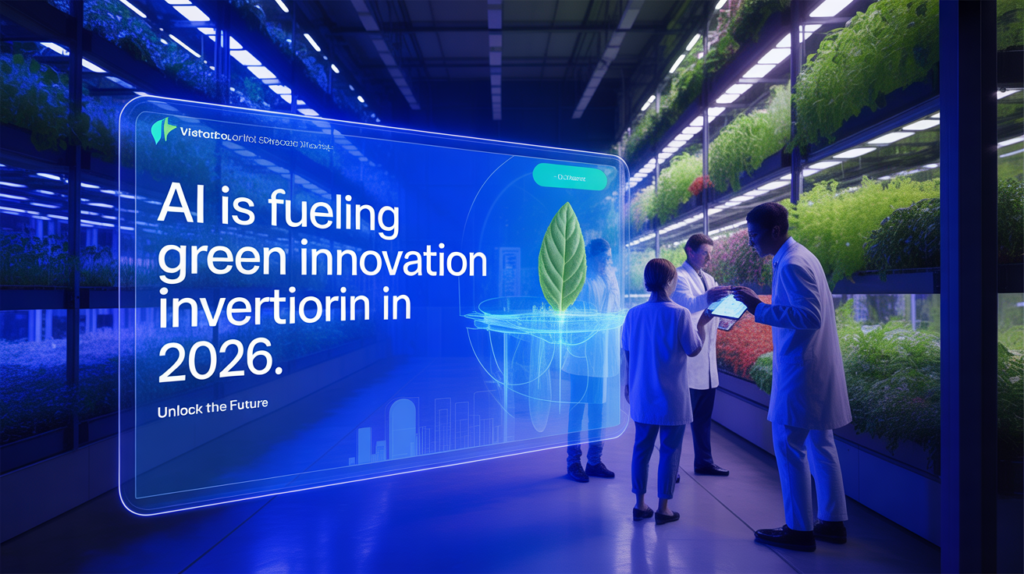
Recent developments suggest that 2025–2026 is becoming a pivotal period for “green AI.” Factors behind this shift include: increasing urgency around climate goals (net-zero targets, carbon neutrality), growing investments in AI-driven sustainability tools, and major breakthroughs in applying AI to real-world environmental problems. As one recent initiative shows, AI is helping locate a commercially viable geothermal energy source something that was elusive for decades.
Moreover, research and industry are aligning: academic proposals like energy-efficient “Green AI” architectures justify AI use not just for performance but for sustainability, enabling circular-economy workflows, waste reduction, and energy-efficient computation.
In short, what once looked like sci-fi idealism AI curing environmental ills is fast becoming practical reality.
How AI Is Driving Green Innovation in 2026
Here are major domains where AI is already fueling green transformation.
🌱 1. Renewable Energy & Clean Power
- Geothermal Discovery Made Easier: In a headline-making move, a company recently announced discovery of a viable geothermal system “the first in over 30 years” thanks to AI-based subsurface modeling and better targeting that avoids costly, wasted drilling.
- Smart Grid & Clean-Energy Optimization: AI increasingly helps forecast renewable energy output (solar, wind), anticipate demand, and balance load. This makes renewables more reliable and reduces reliance on fossil-fuel backup systems.
- Efficient Data-Center Power Use: Big tech players aware of the energy load of AI are themselves using AI to optimize data-center cooling, power use, and resource management. This demonstrates a commitment to minimizing AI’s own carbon footprint even as it supports green projects.
🌳 2. Conservation, Ecosystems & Climate Modelling
- Forest, Ice, and Ocean Monitoring: AI-powered satellite image analysis can now track deforestation, melting icebergs, ocean pollution, and more thousands of times faster and more accurately than manual methods. That helps scientists understand environmental changes and act before irreversible damage occurs.
- Biodiversity & Wildlife Protection: From monitoring endangered species to tracking illegal logging or ocean plastic, AI-enabled sensors, drones, and image-recognition systems make it possible to guard natural habitats proactively.
- Improved Climate Prediction & Policy Modelling: AI can simulate complex climate systems, forecast extreme weather events more precisely, and help policymakers test “what-if” scenarios from emissions trajectories to ecological restoration plans.
🌾 3. Sustainable Agriculture & Food Systems
- Precision Farming & Resource-Smart Agriculture: AI-driven solutions often paired with IoT sensors analyze soil health, water availability, weather forecasts, and pest risks to recommend optimal crop choices, irrigation schedules, and fertilizer/pesticide usage. This reduces environmental burden while maintaining yields.
- Enhancing Crop Resilience & Reducing Waste: When combined with predictive analytics, AI helps farmers adapt to climate shifts, prevent crop losses, and optimize harvests crucial as climate change affects rainfall and seasons globally.
- Supporting Small Farmers and Food Security: Projects targeting smallholder communities often vulnerable to climate shocks use AI to deliver actionable, localized insights, especially important in developing regions.
🔄 4. Circular Economy, Waste Management & Resource Efficiency
- Smart Recycling & Waste Sorting: AI-based waste management systems combining image recognition, sensor data, and automation can classify and sort waste with high accuracy, recovering recyclable materials efficiently and reducing landfill load.
- Energy-Efficient “Green AI” Systems: Researchers have proposed AI architectures that themselves consume less energy and are optimized for circular-economy use. Such frameworks reduce electricity use, improve resource recovery (e.g. battery recycling), and lower environmental impact compared to traditional AI workflows.
- Sustainable Industry & Supply Chain Optimization: By analyzing production, supply chain logistics, resource flows, and waste streams, AI helps industries reduce emissions, curb overproduction, and optimize material usage helping shift industrial economies toward lower carbon footprints.
Benefits and Trade-Offs: A Balanced View
While the promise of AI-driven green innovation is immense, it’s important to hold a balanced view.
| ✅ Benefits | ⚠️ Challenges / Trade-offs |
|---|---|
| Faster, data-driven environmental monitoring (forests, oceans, climate). | AI infrastructure (data centers, GPUs) consumes a lot of power potentially increasing emissions if powered by fossil fuels. |
| Better resource efficiency in energy, water, waste enabling circular economy. | Scaling AI solutions globally especially in regions with limited digital infrastructure remains a challenge. |
| More resilient agriculture, lower chemical use, improved food security. | Access and equity: small farmers and low-income regions may lack access to these advanced tools. |
| Renewable energy optimization, smart grids, clean-power forecasting. | Dependence on good data, policy support, and investments; without alignment, gains may be limited. |
| Scalable interventions from local to global ecosystems. | Risk of “Greenwashing”: companies may overstate AI benefits while neglecting broader environmental responsibilities. |
Importantly, some reports warn that increasing AI usage will raise electricity demand which could offset some of the environmental gains if not carefully managed
That’s why “green AI” research i.e., architectures and systems designed with energy efficiency, circular economy, and sustainability in mind is becoming more central.

What’s New in 2026: Emerging Trends & Examples
- AI is enabling new renewable-energy discoveries. The recent discovery of a viable geothermal energy site (the first in decades) using AI-driven geological modeling shows that AI can unlock energy sources previously too costly or unpredictable.
- Green AI architectures for circular economies. Researchers in 2025 proposed meta-frameworks for “green AI” reducing energy consumption, improving waste and resource management (e.g. battery recycling, urban waste sorting), and enabling scalable circular economy solutions.
- AI-powered agriculture reaching smallholders and vulnerable regions. Projects like those highlighted in global forums are using AI to make low-emission, climate-resilient farming accessible even to small-scale farmers, helping food security while reducing environmental stress.
- Better climate modeling and data-driven policy planning. AI’s growing role in climate simulations, forecasting, and policy-modeling is enabling governments and organizations to test emission-reduction strategies, disaster preparedness and resource planning with more confidence.
These examples suggest that 2026 isn’t just a continuation but a scaling-up and maturation. Projects are moving from pilot or research phases into practical deployment, and AI’s green role is increasingly taken seriously by industry, academia, and policymakers alike.
What Needs Attention: Risks & What We Must Do
- Energy Source for AI Infrastructure: If data centers and AI labs continue to rely on carbon-intensive electricity, the net environmental benefit could be negated. Transitioning AI infrastructure to renewable energy is essential.
- Data Access and Digital Equity: For AI-driven solutions to be globally effective, including in developing countries there must be investments in digital infrastructure, training, and equitable access.
- Policy, Regulation, and Oversight: For AI to truly support sustainability, governments and regulators must incentivize green AI, support renewable power, enforce emissions standards, and promote transparent reporting.
- Avoid Over-Reliance or Greenwashing: AI is a tool, not a silver bullet. Environmental degradation is systemic. Over-relying on AI without addressing core issues (overconsumption, policy inertia, economic incentives) can create a false sense of progress.
The Road Ahead: What 2026–2030 Could Look Like
- Widespread adoption of “Green AI” standards: Just as there are building codes for energy efficiency, we may see global standards for AI infrastructure energy use, carbon accounting, and resource sustainability.
- AI-driven circular economies: Waste sorting, recycling, e-waste management (especially important for electronics-heavy societies) could become largely automated and optimized.
- Renewable energy breakthroughs accelerated by AI: From geothermal and wind to solar and beyond AI may help discover and optimize new clean-energy sources more quickly and cheaply.
- AI supporting resilient agriculture & food systems globally: As climate change pressures mount, AI-enabled agriculture could ensure food security while reducing environmental footprint — critical for sustainability and social stability.
- Better policy and climate planning: Governments worldwide could leverage AI for climate modeling, disaster preparation, emissions forecasting supporting evidence-based policy rather than reactive measures.
Conclusion | AI Is Fueling Green Innovation in 2026
In 2026, we are witnessing something remarkable: AI is transforming from a high-tech novelty into a linchpin of global sustainability efforts. From enabling breakthrough clean-energy projects to optimizing agriculture, waste, conservation, and climate planning AI is fueling green innovation in ways once thought improbable.
The potential is enormous but realizing it will require more than technology: it demands vision, policy support, equitable access, and collective responsibility. If we rise to that challenge, AI could well become one of the defining tools of humanity’s ecological redemption.
Also Read: “Biodegradable Tech Is Rising in 2026“
FAQ’s
Q. Doesn’t AI itself consume a lot of energy, isn’t that counter-productive for the environment?
Yes training large AI models and running data centers requires substantial electricity. That’s why “green AI” (energy-efficient architectures, optimized workloads, renewable-powered data centers) is so important. When implemented responsibly, AI’s environmental benefits often outweigh its costs.
Q. Can AI really help small farmers and underdeveloped regions, or is it only for large corporations?
AI’s reach is expanding. Several projects in emerging economies use low-cost sensors, edge computing, and smartphone-based tools to deliver actionable climate-smart farming advice to smallholders. Governments and NGOs play a key role in scaling these tools.
Q. Does AI solve climate change on its own?
No. AI is a tool powerful, but not a magic wand. It can accelerate decarbonization, enable efficient resource use, help monitor ecosystems but systemic changes (policy, behavior, economic incentives) are still essential.
Q. What are the risks of relying too much on AI for sustainability?
Risks include increased energy demand, overconfidence in technological fixes (overlooking social, political, economic causes), digital inequality, potential misuse or greenwashing. Responsible deployment, transparency, regulation and combining AI with broader systemic reforms are necessary.