







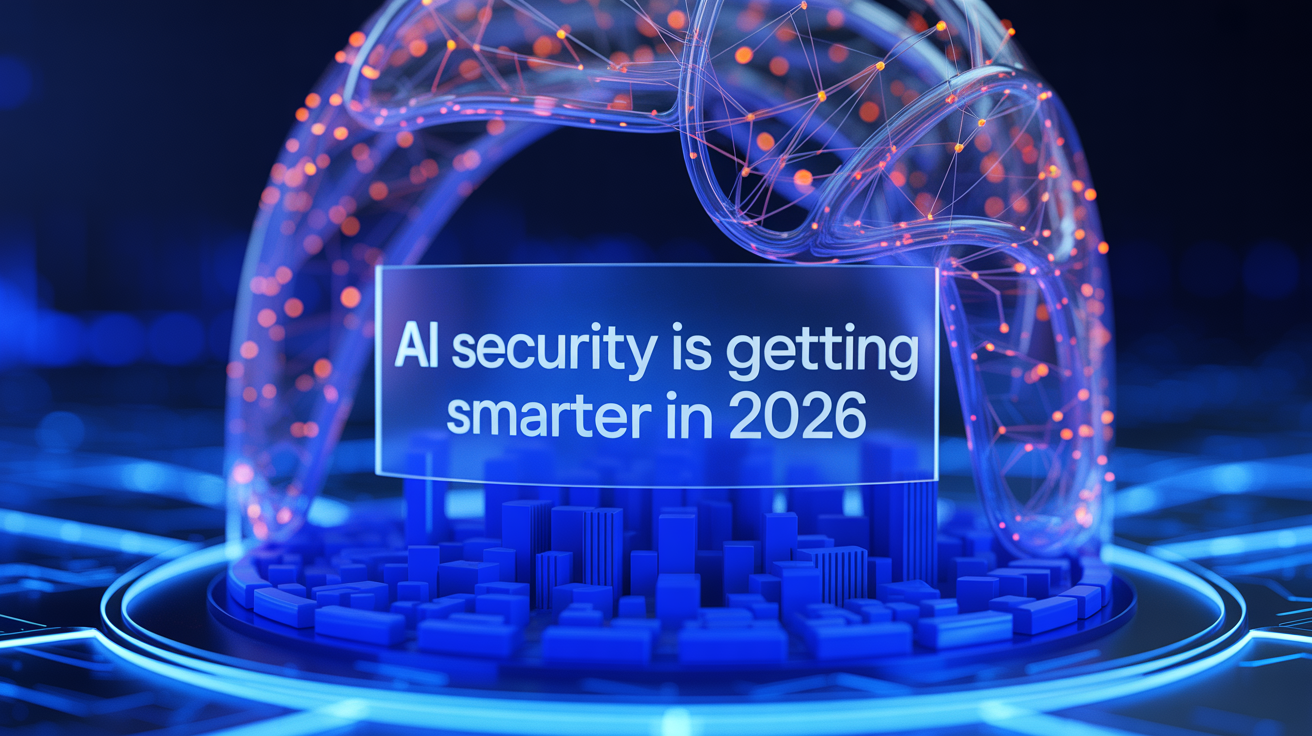
As we move deeper into 2026, the world of cybersecurity undergoes a dramatic transformation one driven by the very force that once threatened it: artificial intelligence (AI). In what feels like a digital arms race, AI is now powering both cutting-edge attacks and the defenses meant to stop them. In this article, we explore how “AI security” has evolved why 2026 could well be remembered as the turning point and what organizations, governments, and individuals must do to stay safe. AI Security Is Getting Smarter in 2026.
Table of Contents
Why 2026 Is a Pivotal Year for AI Security
Several recent industry reports and expert forecasts indicate that 2026 marks a fundamental shift: AI is no longer just a tool it is the battlefield.
- Google cautioned in its 2026 Cybersecurity Forecast that AI will supercharge cybercrime, enabling attackers to automate phishing campaigns, clone voices, and scale disinformation.
- Trend Micro predicts 2026 will be the year “cybercrime becomes fully industrialised,” thanks to AI and automation.
- At the same time, defenders are reacting in kind: autonomous AI-powered defense systems are emerging tools that can hunt threats, detect anomalies, and respond in real time.
In short: 2026 marks the shift from human-centred cybersecurity to machine vs. machine cybersecurity.
Key Trends Shaping AI Security in 2026
Here’s how AI is redefining cybersecurity, for better and worse.
Autonomous / Agentic AI: The New Frontier for Attack and Defense
Autonomous AI agents algorithms that act, learn, and adapt with minimal human oversight are rapidly becoming the norm on both sides of the cyber war.
| Use Case | Defensive Use | Offensive Use / Threat |
|---|---|---|
| Network monitoring & response | AI agents automatically detect intrusions, isolate compromised assets, and remediate threats in real time. | Attackers deploy AI bots for reconnaissance, lateral movement, and data theft faster and more stealthily than human hackers. |
| Behavior-based detection | Machine-learning baselines model “normal” behavior for devices/users and flag anomalies (e.g. insider threats). | AI-driven malware adapts behavior dynamically to evade detection, or automated phishing spear-phishing scales rapidly. |
Security organizations are being forced to rethink strategies: not just patching vulnerabilities, but actively monitoring, analyzing and governing AI agents as if they were employees.
Deepfakes, Synthetic Identities & Identity Threats
One of the most alarming developments is the rise of deepfake technology, synthetic media, and AI-generated identities. These are no longer sci-fi fantasies they are the front lines of identity fraud, social engineering and digital impersonation.
- Forged videos, voice clones, or synthetic images can trick employees or systems into believing that a legitimate executive, colleague or partner is requesting sensitive actions leading to costly breaches or unauthorised transactions.
- As a result, identity has become the “primary battleground.” Security teams are now focusing on validating not just human credentials, but machine/agent identities and AI-generated personas.
This shift calls for fundamentally stronger identity verification, continuous authentication, and robust governance frameworks not just for people, but also for machines and AI agents.
Zero Trust Evolves to Zero Trust 2.0 with AI
Traditional perimeter-based defenses are becoming obsolete. In their place emerges a new, AI-infused version of the Zero Trust Architecture (ZTA) one that continuously assesses risk, monitors user/device behavior, and adapts access rights in real time.
- For example, login activity from an expected device and location may be granted seamlessly but an odd login attempt (different city, unusual time) can trigger multi-factor authentication (MFA), behavioral checks, or temporary lockdowns automatically.
- This dynamic, contextual approach drastically reduces the risk of credential misuse, insider threats, and unauthorized access especially important given today’s hybrid work environments and remote access demands.
In 2026, Zero Trust isn’t just a philosophy it’s an AI-driven security fabric.
AI-Powered Threat Detection, Adaptive Firewalls & Self-Healing Security
Beyond identity, AI is transforming traditional cybersecurity tools turning them “smart,” adaptive, and even self-healing.
- Adaptive Firewalls Next-generation firewalls now use machine learning to analyze network traffic patterns in real-time, detecting anomalies and preventing intrusions automatically.
- Anomaly & Behavior Monitoring AI-driven systems monitor user, network, and device behavior at scale, flagging deviations such as odd login times, unusual data access, or unexpected file transfers.
- Self-Healing & Rapid Response Some platforms predict vulnerabilities before they’re exploited and patch them proactively; others isolate affected components automatically once malicious activity is detected.
These capabilities give defenders the upper hand but only if they adopt them. In an increasingly automated threat landscape, manual-only security teams may soon become obsolete.
The Dark Side: What Makes 2026 Riskier Than Ever
As much as AI strengthens security, it also magnifies risk. Here are some of the biggest challenges:
- Escalation in AI-Powered Attacks: Phishing, ransomware, malware, identity fraud all enhanced by AI are growing in volume, sophistication, and scale.
- AI Agents as Insider Threats: Autonomous agents often have privileged access. If compromised (or tricked), they become a potent new kind of insider threat.
- Governance Gaps & Blind Spots: Many organisations still treat AI like a “nice-to-have” feature rather than a core part of infrastructure. They lack oversight, auditing, or governance for AI agents, leaving “ghost identities” or unmonitored access points.
- Adversarial AI & Evading Detection: Attackers will use AI to obfuscate, adapt, and evade detection constantly changing tactics to stay ahead of defenders.
In 2026, if you don’t treat AI as the central pillar of your security strategy you are vulnerable.
What Organizations Should Do to Stay Ahead
If you’re responsible for IT security, here are actionable priorities for 2026:
- Adopt AI-based security platforms: Shift from legacy tools to ML-powered firewalls, anomaly detection, and AI-driven threat response.
- Implement Zero Trust 2.0: Use context-aware, continuous authentication and adaptive access control for users, devices, and agents.
- Treat AI agents as first-class citizens: Give them identities, permissions, and audit logs just like human users; monitor their behavior.
- Strengthen identity verification & anti-deepfake defenses: Deploy biometric authentication, multi-factor authentication (MFA), and deepfake detection tools.
- Continuous training & awareness: Educate employees about AI-powered phishing, voice cloning, social engineering, humans remain the weakest link.
- Governance and compliance: Develop policies around AI use, logging, access rights, and incident response for AI-driven systems.
What’s New in 2026: From Predictions to Reality
What was once speculative just a few years ago is now becoming real and tangible:
- The prediction of fully automated cybercrime by Trend Micro is trending from theory to reality, as attackers deploy AI bots to scan, infiltrate, and exploit at scale.
- Enterprises are increasingly adopting AI-driven detection and adaptive security at scale
- moving beyond proof-of-concept to production deployments.
- The battlefield is shifting: identity, AI-agent governance, and adaptive architectures are now the central concerns for cybersecurity teams, not just firewalls or antivirus.
In short: AI security is not a future concept it’s already shaping the cybersecurity landscape in 2026.
Also Read: “The Shocking Future of AI Jobs in 2026“
Conclusion
2026 is more than just another year for cybersecurity: it is a turning point. AI which once threatened data and privacy is now doubling down as both weapon and shield. The winners will be those who recognise that AI isn’t just a tool it’s the new security architecture.
Organizations and individuals must adapt fast: deploying AI-driven defenses, embracing adaptive architectures, and treating AI agents and identities with the same rigor as human users.
FAQ’s
Q: If AI helps both attackers and defenders, doesn’t that balance out?
A: Not exactly. While AI strengthens defenses, it also gives attackers a scalable, automated advantage. Many attackers now deploy AI at machine scale meaning speed, stealth, and volume which can overwhelm traditional, human-driven defenses.
Q: What is “agentic AI” and why is it important for security?
A: Agentic AI refers to autonomous AI systems that can act, learn, and adapt without constant human oversight. In cybersecurity, they matter because they can both detect threats faster than humans and, if hijacked or misused, can act as powerful insider threats.
Q: Are traditional firewalls and antivirus tools still useful in 2026?
A: They still have value, but are no longer enough on their own. The modern threat landscape demands adaptive, AI-driven firewalls, behavior monitoring, continuous authentication capabilities traditional tools lack.
Q: What kinds of organisations need to worry most about AI-driven threats?
A: Virtually all but especially those with valuable data, remote/hybrid workforces, or reliance on automation (cloud providers, finance, healthcare, enterprises). As identity and AI-agent threats grow, no sector is immune.
Q: Do individuals need to worry too, or is this only for enterprises?
A: Yes, individuals are at growing risk too. AI-powered social engineering, deepfake voice-calls, phishing, and identity fraud can target anyone. Using strong passwords, MFA, cautious online behavior and being aware of deepfakes helps.