










In 2026, some of the world’s largest technology companies often grouped under the banner “Big Tech” are doubling down on sustainability and environmental responsibility. As data-center expansion, AI workloads, and cloud infrastructure grow at breakneck speed, these firms are increasingly aware that “business as usual” is no longer tenable. This article explores how Big Tech is embracing the green transition, the strategies they’re adopting, the challenges they face and what it might mean for the future of technology and the planet. Big Tech Goes Green in 2026.
Big Tech Goes Green in 2026 – FAQ Quiz
1. What does “Big Tech goes green” mainly mean in 2026?
2. Why are tech companies focusing on sustainability now?
3. How are data centers becoming more eco-friendly?
4. Which renewable energy sources are Big Tech using most?
5. How does AI help Big Tech reduce emissions?
6. Are green initiatives saving money for tech companies?
7. How are tech products becoming more sustainable?
8. What role do governments play in green tech adoption?
9. How does going green impact Big Tech brand image?
10. What can users do to support green tech initiatives?
Table of Contents
Why Going Green Matters for Big Tech

Big Tech companies power our digital age. From cloud computing to AI, from smartphones to enterprise software their infrastructure underpins nearly every dimension of modern life. But that infrastructure carries heavy environmental costs: data centers consume massive amounts of electricity and water, manufacturing devices involves resource-intensive supply chains, and e-waste continues to grow.
For companies with global footprints and massive environmental impact, embracing sustainability is not just about PR it’s about long-term viability, regulatory compliance, social responsibility, and even future-proofing their businesses.
In 2026, this urgency has reached a tipping point. With rising scrutiny from regulators, investors, and society, “going green” is shifting from optional to essential.
What Big Tech Is Doing: Key Trends & Commitments
Here are some of the most important green initiatives from leading tech firms as of 2025–2026.
Massive Investments in Renewable Energy & Carbon Removal
- Microsoft and Alphabet (parent of Google) have together committed more than US$10 billion toward durable carbon-removal and clean-energy projects.
- Microsoft has contracted tens of gigawatts of carbon-free electricity across dozens of countries and supports green startups via its Climate Innovation Fund.
- Similarly, other firms are using power-purchase agreements (PPAs), on-site renewables, or offsite clean energy to cover at least part of their electricity demand.
Energy-Efficient Infrastructure & Data Centers
As the demands of AI, cloud, and web services grow, tech firms are redesigning their backbone infrastructure to be more sustainable:
- Microsoft is building data centers using mass-timber construction, reducing the embodied carbon of the building structure by up to 65 % compared to conventional concrete/steel buildings.
- It is also adopting energy-efficient cooling, transmission upgrades, and software to optimize energy and reduce waste across its cloud services.
- Hardware firms like Nvidia are improving energy efficiency of their chips. Their latest generation GPUs (e.g., “Blackwell” architecture) are engineered to deliver much higher performance per watt for AI workloads helping data centers manage AI’s energy hunger.
Circular Economy, E-Waste and Supply-Chain Reforms
Sustainability doesn’t end at energy. Several top firms are rethinking manufacturing, packaging, waste, and supply-chain emissions:
- Companies like HP and Dell have committed to using a high proportion of recycled or renewable materials in their products and packaging helping reduce resource depletion and e-waste.
- Meanwhile, beyond hardware players, major tech firms have ramped up transparency and begun setting goals for emissions across their operations and supply chains though, as we shall see, gaps remain.
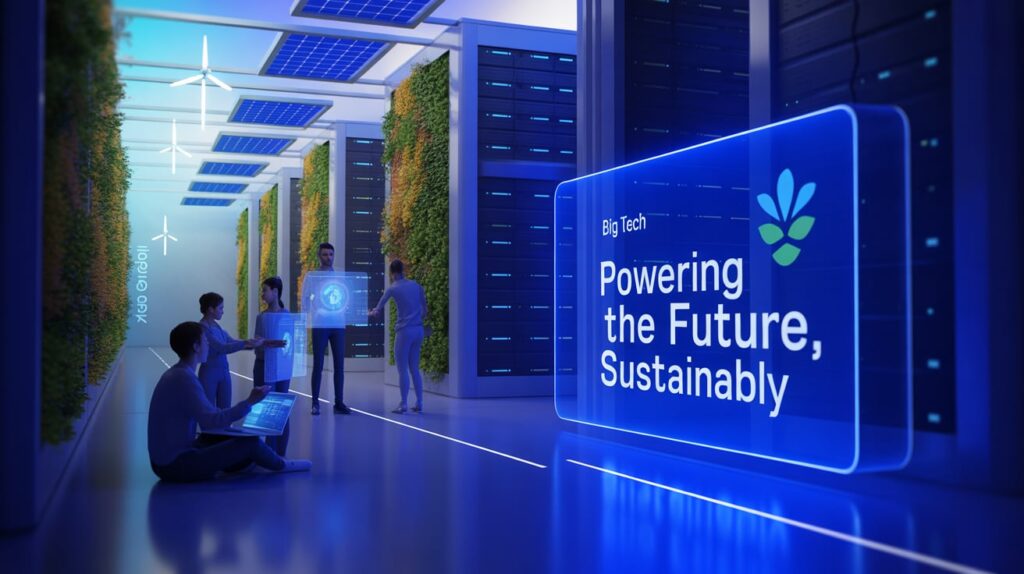
2026’s Green Tech Reality, Achievements & Emerging Challenges
While the strides are significant, 2026 is also a moment of reckoning. As commitments mature, new challenges and contradictions are becoming clear.
Wins: Concrete Progress Toward Clean Energy Goals
| Company / Sector | What’s Working / Achievements |
|---|---|
| Microsoft & Alphabet | Large investments in carbon removal; clean-energy PPAs; carbon-free electricity across many sites. |
| Data center construction methods | Use of mass-timber and energy-efficient design cuts embodied carbon for new facilities. |
| Hardware / Device Makers (HP, Dell, etc.) | Shift to recycled/renewable materials, reduced single-use plastic, circular-economy approach. |
| Green-tech investment & startups | Big Tech funding helps scale carbon-removal and other clean-technology innovations. |
These successes show that major tech firms are not merely paying lip service they are deploying capital, changing infrastructure, and building long-term strategies that integrate sustainability.
Headwinds & Growing Pains
However, sustainability for Big Tech is more complex than ticking “use renewables” or “invest in carbon credits.” Several issues stand out.
- Supply-chain transparency is still weak. An analysis ranking major tech firms found that except for one most receive low marks for disclosing supply-chain electricity consumption or emissions.
- Energy & resource demands are exploding, especially due to AI and expanded cloud computing. Some experts warn that rising demand may outpace progress on clean energy.
- Trade-offs remain between energy and water use. Emerging research shows that optimizing for carbon footprint alone can worsen water consumption a concern for large data center operations.
- Policy, accounting, and standards are evolving. As regulators and standard-setting bodies tighten rules on how companies claim “renewable” energy or net-zero status, Big Tech may need to adapt rapidly to ensure credibility not just optics.
The 2026 Inflection Point: What’s Changed, and What’s at Stake
2026 is shaping up to be an inflection point for tech industry sustainability. A few factors are converging:
- Scale of demand: The explosion of AI, cloud computing, and data-driven services means energy demand is rising exponentially. If unmanaged, this could easily offset earlier efficiency gains.
- Investor and regulatory pressure: With climate concerns accelerating globally, companies are under growing pressure not just from consumers but from investors, governments, and regulators, to deliver real, measurable progress.
- Innovation in clean tech & green infra: Thanks to Big Tech’s capital, carbon removal, energy-efficient hardware, circular supply-chains, and sustainable data-center designs seem more viable than ever.
- Corporate responsibility redefined: For many companies, sustainability is no longer a side project. It’s becoming core to business strategy and long-term resilience.
If these trends hold, the next few years could see Big Tech evolve from being part of the problem to a major part of the solution setting new standards for digital infrastructure worldwide.
What It Means for Users, Businesses & the Planet
- For end-users, more sustainable tech could mean greener supply chains, products made with recycled materials, and services powered by clean energy. That adds up not just for the planet, but also for long-term resilience.
- For businesses (especially SMEs and startups), Big Tech’s push can help create a broader ecosystem of clean-tech tools, carbon-tracking services, and green infrastructure making sustainability more accessible.
- For the planet, if Big Tech successfully scales clean energy, carbon removal, and circular production at this scale it could substantially reduce emissions from one of the world’s most resource-intensive sectors.

Why 2026 Might Be the Year Green Tech Goes Mainstream
2026 is not just about more pledges it’s about real, structural change. The combination of urgency (rising resource demands), capability (capital, innovation, engineering), and pressure (regulation, social expectations) is forcing Big Tech to treat sustainability as a core part of business.
In many ways, this year could mark the moment when “green computing” transitions from marketing gloss to business-as-usual.
That doesn’t mean the road ahead will be smooth there are real scale, transparency, and resource challenges. But the direction is clear: Big Tech is going green, and if successful, it could reshape not just the tech industry but the environmental trajectory of the global digital economy.
Conclusion
As we move deeper into 2026, Big Tech’s green pivot is no longer symbolic it’s structural. The wave of renewable-energy deals, carbon-removal investments, energy-efficient infrastructure, and circular manufacturing shows that major technology companies are rethinking how they build, operate, and scale.
Yes challenges remain. Supply-chain emissions, resource consumption, accountability, and the sheer scale of growth in AI and cloud services all pose serious headwinds. But the direction is promising.
If Big Tech can deliver on its green ambitions, 2026 may be remembered as the year the tech industry began to align profitability with planetary responsibility. And for consumers, businesses, and the environment alike that could be a game changer.
Also Read: “Biodegradable Tech Is Rising in 2026“
FAQ’s
Q1. Which big tech companies are leading in green initiatives?
Companies like Microsoft, Alphabet/Google, HP, Dell, and Intel are among the leaders. Microsoft and Google, for instance, have committed billions to carbon removal and clean energy, while HP and Dell focus on circular manufacturing and recycled materials.
Q2. What kinds of strategies are used to make data centers greener?
Strategies include sourcing electricity from renewables (via PPAs or on-site renewables), designing data centers with low-carbon materials (e.g. timber construction), improving cooling and energy efficiency, and investing in more efficient hardware such as energy-optimized GPUs.
Q3. Are there downsides or trade-offs when tech companies go green?
Yes, for example, increasing computing demand (especially from AI) can raise energy and water consumption. Also, supply-chain transparency remains uneven, and companies may struggle to fully account for or mitigate indirect emissions (e.g. from manufacturing or logistics).
Q4. Does “using renewable energy” really make a difference?
Yes, when done properly. Clean-energy procurement (e.g. via renewable energy credits or PPAs) helps reduce reliance on fossil fuels, and when combined with energy-efficient infrastructure and carbon removal, can significantly lower a company’s carbon footprint. However, credibility depends on transparent accounting and real, traceable clean energy usage.
Q5. What should we watch for in the coming years?
More stringent global standards and regulations around carbon accounting and supply-chain transparency.
Growing emphasis on carbon removal and offset scaling.
Continued innovation in energy-efficient hardware, sustainable data-center design, and circular manufacturing.
Broader adoption of green-tech solutions across industries, often powered by Big Tech’s investments and infrastructure.