








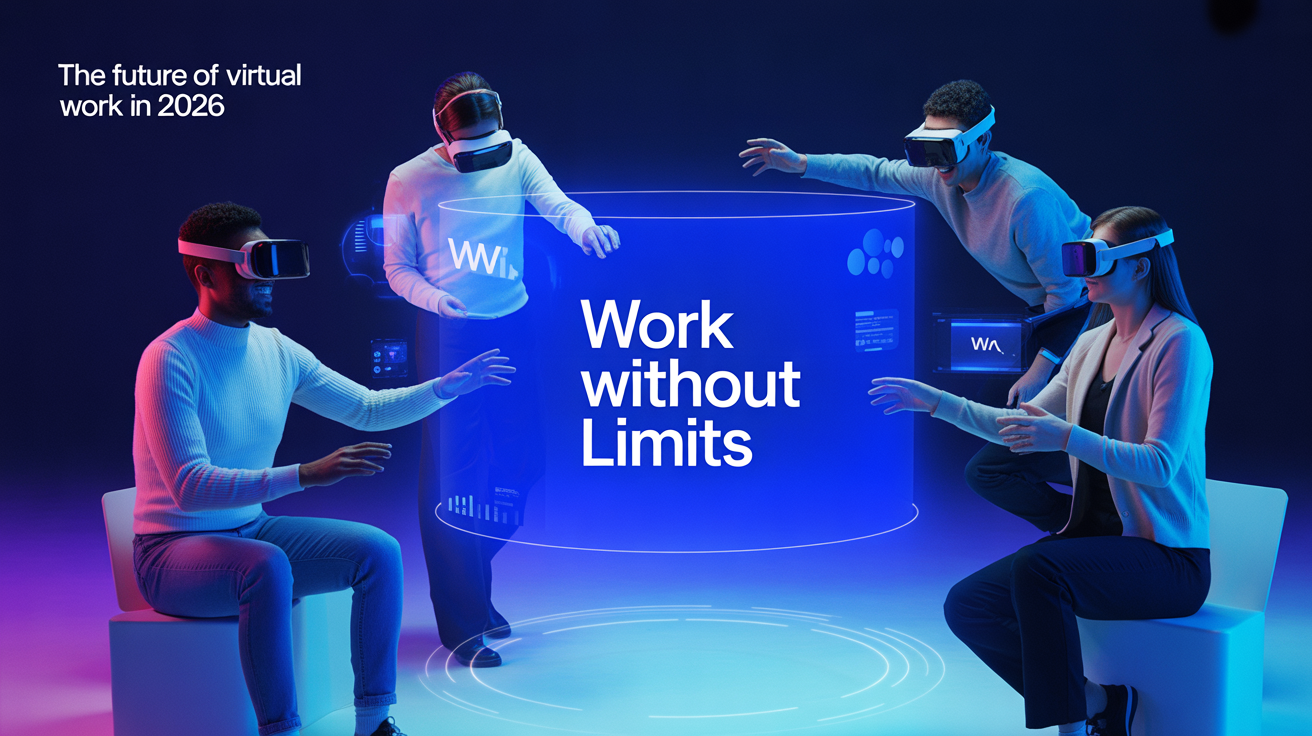
The global workplace is undergoing one of the most fundamental transformations since the industrial revolution a shift from traditional offices to virtual, hybrid, and digitally mediated work. As we approach 2026, the contours of “work” are being redrawn by technology, changing worker expectations, and evolving business strategies. In this article, we explore where virtual work is headed, what it might look like in 2026, and what both employers and employees must prepare for. The Future of Virtual Work in 2026.
Table of Contents
Where We Stand Today: Remote Work in 2025
Before projecting into 2026, it helps to understand the status quo as of 2024–2025:
- In India, about 12.7% of full-time employees reportedly work from home, while 28.2% follow a hybrid (“some days home, some days office”) schedule.
- Globally, remote-capable jobs remain substantial: according to one source, 56% of U.S. jobs could be done remotely at least partially.
- Among remote-capable employees, many choose hybrid arrangements: recent estimates show a significant portion of workers splitting time between home and office.
- Employee sentiment remains strongly in favor of flexibility: many remote workers appreciate the time saved (no commute), improved work-life balance, and autonomy over work location and schedule.
These growing trends reflect that remote and hybrid work models are now more than a pandemic-era experiment they are embedded structural features of modern labor markets.
What to Expect in 2026: Predictions & Trends
Based on current data and expert analyses, here are some of the key developments likely to shape virtual work by 2026:
Hybrid + Flexible Work Will Dominate
Fully remote setups remain viable but hybrid models will likely be the norm in many industries. Companies are refining “return-to-office” policies, balancing collaboration needs with flexibility. Some are expected to tie in-office days to project milestones, team sprints, onboarding, or mentorship sessions rather than fixed days.
This approach sometimes described as outcome-based presence emphasizes productivity and collaboration impact over traditional 9-to-5 attendance.
Virtual Work Gets Technologically Smarter: AI, VR, and Beyond
Technology will further blur the line between in-person and virtual collaboration. Key enablers:
- Advanced collaboration tools, enhancing asynchronous work and cross-time-zone cooperation.
- Widespread adoption of AI-driven tools for scheduling, project management, and even workload distribution.
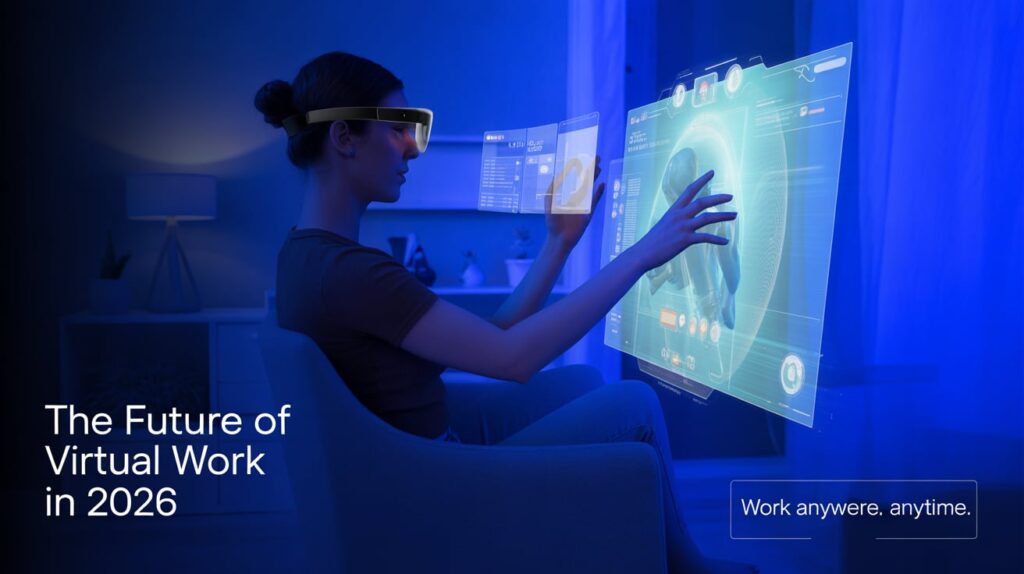
- Growing interest in immersive technologies e.g., virtual reality (VR) or augmented reality (AR) meetings to replicate the feel of in-person interaction, especially for teamwork, brainstorming, or social collaboration.
Some futurists argue that by mid-decade, work will no longer be simply “hybrid” it will become blended, with human workers and AI systems collaborating seamlessly in virtual environments
Global Talent Pools & Borderless Hiring
Virtual work removes geographic constraints. By 2026, organizations are likely to tap into global talent pools, hiring people from different countries, time zones, and cultural backgrounds especially for digital, knowledge-based roles.
This shift benefits both employers (access to a wider skill base, potential cost savings) and employees (more job choices, flexibility, and possibly better compensation). However, managing distributed teams will require better cross-cultural communication, aligned workflows, and robust infrastructure for compliance with diverse labor laws.
New Management, Performance & Security Paradigms
As remote/hybrid work becomes standard, traditional performance metrics and management styles will evolve:
- Output-based performance measurement (rather than hours logged). Many organizations will measure success via deliverables, collaboration outcomes, and project milestones.
- “Trust-based management”: leaders will shift from micromanagement to trust, autonomy, and accountability. This helps sustain morale and innovation in distributed teams.
- Increased focus on cybersecurity, data protection, and privacy: with distributed teams and remote access, companies will likely invest in VPNs, multi-factor authentication, zero-trust security models, and staff training to mitigate growing risks.
Rising Importance of Skills, Learning & Well-Being
Remote work demands more from employees in terms of digital literacy, self-discipline, time management, and communication skills.
To stay relevant in 2026 and beyond, continuous learning and upskilling will be essential not just in job-specific tools, but also in collaboration, virtual communication, multicultural teamwork, and remote project management.
Moreover, companies will need to pay attention to employee well-being and mental health. Remote work can bring flexibility but also isolation, “always-on” fatigue, and blurred boundaries between personal and professional life.
Challenges & Risks of Virtual Work in 2026
While the future looks promising, virtual work comes with its share of challenges. Some that organizations and workers need to address:
| Challenge / Risk | Description |
|---|---|
| Collaboration and Creativity Loss | Without physical proximity and informal interactions, creativity and spontaneous collaboration may suffer. Some organizations report up to 15% drop in effectiveness due to communication lags, lack of social cues, or virtual-meeting overload. |
| Cybersecurity & Data Protection | Remote work increases exposure to cyberattacks, phishing, insecure home networks, and mishandled sensitive data. Companies must invest in robust security systems and training. |
| Work-Life Boundary Blur & Burnout | Without structured routines, employees may overwork, struggle to “switch off,” and experience isolation or mental-health issues. |
| Inequity & Polarization | As remote work concentrates around certain skills, industries, or geographies, there’s a risk of widening inequality: skilled urban workers may benefit, while less-skilled or rural workers may get sidelined. |
What This Means for Employers & Employees
For Employers:
- Reimagine work policies: Favour outcome-based goals, flexible scheduling, and hybrid presence tied to collaboration needs rather than fixed days.
- Invest in technology: Robust collaboration tools, secure remote-access infrastructure, digital productivity tracking, and cybersecurity.
- Promote a culture of trust, autonomy, well-being: Offer mental-health support, encourage breaks, avoid micromanagement, and support lifelong learning.
- Tap global talent: Use remote platforms to hire from anywhere but accompany with strong onboarding, cultural sensitivity training, and compliance frameworks.
For Employees / Professionals:
- Sharpen digital skills: Be comfortable with remote collaboration tools, time-zone coordination, asynchronous workflows.
- Embrace lifelong learning: Upskill in relevant tools, cross-cultural communication, remote project management, virtual teamwork skills.
- Set boundaries & manage well-being: Define work hours, avoid “always on,” prioritize rest and mental health.
- Adapt to hybrid or blended models: Flexibility to combine remote, office-based, and virtual-AI mediated work will be key.
What the Research & Experts Say
- According to multiple surveys, a large majority of remote-capable workers prefer flexibility: many would willingly accept hybrid or remote setups indefinitely.
- Experts predict that hybrid work adoption will continue growing through 2027 and beyond but with increasing sophistication: blending AI-mediated virtual collaboration, global teams, and outcome-based workflows.
- In a provocative but influential recent academic thought piece, some argue that the future of work isn’t “hybrid” it’s “blended.” That is, human-AI collaboration, virtual presence, and algorithmically mediated workflows will reshape how “work” is defined.
Conclusion: Virtual Work Is Not Just a Trend, It’s the Future
By 2026, virtual work will not simply be a legacy of a global pandemic it will have matured into a complex, flexible, and deeply integrated model of work. Organizations and individuals who adapt will benefit from agility, cost savings, access to global talent, and better work-life balance. But those who stick to old norms may struggle as hybrid, blended, and globally distributed work becomes the default.
The future will demand adaptability in mindset, skills, management style, and technology. Those who view virtual work not just as “working from home,” but as a new paradigm of collaboration, communication, and productivity will thrive.
Also Read: “Virtual Worlds Are Growing Fast in 2026“
FAQ’s
Q: Will remote work completely replace offices by 2026?
A: Unlikely. Hybrid and blended work models will dominate, offices will still matter for collaboration, onboarding, innovation sessions, social connection, and tasks needing face-to-face presence.
Q: What kinds of jobs are most likely to remain remote or hybrid?
A: Knowledge-based, digital-first, or tech-oriented roles such as software development, design, digital marketing, consulting, data analysis basically jobs that rely on computers, collaboration tools, and digital workflows.
Q: What are the biggest risks of relying on virtual work?
A: Reduced spontaneous collaboration/creativity, weakened social bonds, mental-health or burnout issues, data-security vulnerabilities, and inequality or skill-based disparities across workforce segments.
Q: How can workers prepare themselves to thrive in 2026’s virtual work world?
A: Invest in digital skills, become comfortable with asynchronous and remote communication tools, build time-management and self-discipline habits, prioritize mental well-being, and embrace continuous learning and cross-cultural collaboration.
Q: What should companies do to ensure virtual work is effective and sustainable?
A: Adopt outcome-based performance evaluation, invest in secure remote infrastructure and collaboration tools, foster a culture of trust and autonomy, support employee well-being, and provide training or upskilling opportunities.