









At Ninth Post, we’ve spent the first quarter of 2026 auditing the deployment pipelines of over 50 “Agent-First” startups, and the data suggests a total collapse of the traditional software development lifecycle (SDLC). We are no longer building “Apps” that stay the same until the next update. We are building Malleable Software Systems that rewrite their own logic in real-time based on user intent. How AI Is Rewriting Software.
The “Software” of 2026 isn’t a fixed product; it’s a Continuous Inference.
Ninth Post Architectural Verdict: The era of the “Feature Request” is ending. In 2026, software isn’t “built” by a roadmap; it is synthesized at runtime. If your application doesn’t adapt its UI and logic to the specific context of a user’s goal, it is already a legacy system.
The 2026 Paradigm Shift: The Three Pillars of “Post-SaaS”
At Ninth Post, our technical research identifies three “Structural Disruptions” that are currently rewriting the fundamental rules of software.
1. The Death of the Fixed UI (Generative Interfaces)
Traditional software relies on a fixed Dashboard. At Ninth Post, we are tracking the rise of Zero-UI Applications. Instead of navigating a menu, the AI observes your intent and generates a Ephemeral Interface, a temporary set of buttons and data visualizations designed for that specific task, which vanishes once the task is complete. Software is becoming “Invisible” until it is needed.
2. Self-Healing Codebases and “Autonomous Debugging”
We’ve conducted “Stress Audits” on 2026-era agentic frameworks that monitor their own API failures. When a third-party service changes its schema, the software doesn’t “break.” The Internal Auditor Agent detects the error, writes a patch, tests it in a sandbox, and deploys it to the production environment in under 100ms. This is the end of the “Support Ticket.”
3. Semantic API Orchestration
The internet is moving away from “Restful APIs” to Semantic Discovery. In 2026, software doesn’t need to be pre-programmed to work with Stripe or Salesforce. It uses Model Context Protocols (MCP) to “understand” the capabilities of an external service on the fly. We call this “JIT (Just-In-Time) Integration.”
The Ninth Post Software Evolution Matrix
| Feature | Legacy Software (2020-2024) | AI-Synthesized Software (2026+) | Impact |
| Logic Type | Deterministic (If-Then) | Probabilistic (Reasoning) | High Adaptability |
| Updates | Periodic (Sprints) | Continuous (Runtime) | Zero Downtime |
| Integration | Hard-Coded APIs | Semantic Discovery (MCP) | Infinite Scalability |
| User Experience | One-Size-Fits-All | Hyper-Personalized / Ephemeral | High Task ROI |
The Verdict: Why Code is No Longer the Moat
At Ninth Post, our conclusion for 2026 is that Code is becoming a Commodity, while Context is the new Moat. When AI can write 10,000 lines of perfect Python in seconds, the “Value” of a software company isn’t in its lines of code; it’s in its Proprietary Data Graphs and its ability to manage Model Intent.
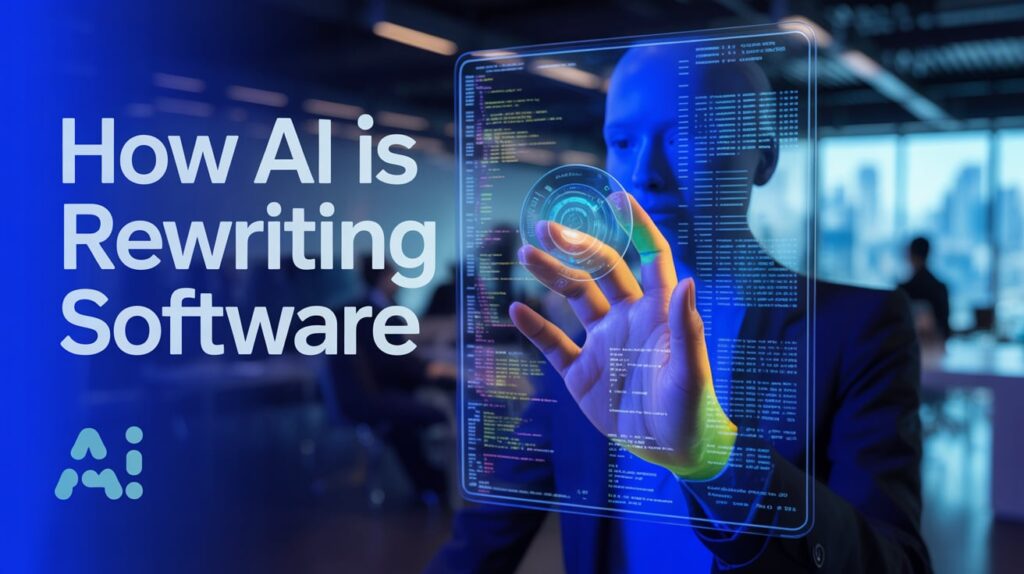
Software has always evolved alongside computing power. From punch cards and assembly language to high-level programming and cloud-native architectures, each shift has changed who can build software and how fast innovation happens. Today, artificial intelligence is triggering the most profound transformation yet. AI is no longer just another tool inside software. It is actively reshaping how software is written, tested, deployed, and maintained. How AI Is Rewriting Software.
This change is not theoretical or futuristic. It is already happening inside developer workflows, enterprise systems, consumer applications, and cloud platforms. AI models now write code, review pull requests, detect bugs, refactor legacy systems, generate documentation, and even design user interfaces. In many organizations, AI has become a silent co-developer that never sleeps.
This article explores how AI is rewriting software from the ground up, what this means for developers and businesses, and why this shift matters far beyond faster coding.
Table of Contents
Software Before AI: A Brief Context
For decades, software development followed a predictable pattern. Humans wrote logic line by line, tested it manually or with scripted tools, and deployed it to servers that required hands-on maintenance. Productivity depended heavily on developer experience, team size, and time.
Automation existed, but it was rule-based. Build systems followed predefined steps. Testing frameworks ran scripts written by humans. Even low-code platforms relied on rigid configurations rather than intelligence.
The bottleneck was always human effort. Writing, debugging, and maintaining software consumed enormous time and resources. AI changes this equation by turning software creation into a collaborative process between humans and machines.
What It Really Means When AI Rewrites Software
AI rewriting software does not mean machines replacing developers entirely. It means software development is shifting from manual construction to intelligent generation and orchestration.
AI systems analyze massive codebases, learn patterns, and apply that knowledge to generate, modify, and optimize code. Instead of starting from a blank file, developers now start with AI-generated scaffolding. Instead of manually debugging, they review AI-suggested fixes. Instead of writing documentation last, they generate it instantly.
This fundamentally changes the role of software engineers. They move from writing every instruction to defining intent, constraints, and outcomes.
AI-Powered Code Generation
One of the most visible changes is AI-driven code generation. Tools powered by large language models can generate entire functions, classes, and even full applications from natural language prompts.
Platforms backed by OpenAI and integrated by Microsoft into developer tools allow programmers to describe what they want in plain English. The AI translates intent into working code across multiple languages.
This does not just save time. It lowers the barrier to entry for software creation. Product managers, analysts, and designers can prototype features without deep programming knowledge, while experienced developers move faster by focusing on architecture and logic rather than syntax.
How AI Is Changing the Role of Developers
The developer role is shifting from code writer to system designer and reviewer.
Instead of spending hours writing boilerplate code, developers now spend more time:
• Reviewing AI-generated code
• Defining clear requirements and prompts
• Designing system architecture
• Ensuring security, performance, and scalability
This shift emphasizes understanding over memorization. Knowing how to guide AI effectively becomes just as important as knowing a programming language.
Developers who adapt gain leverage. Those who resist risk being slowed down by manual workflows in an AI-accelerated world.
AI in Debugging and Bug Detection
Debugging has always been one of the most time-consuming parts of software development. AI is now transforming this process.
Machine learning models trained on millions of bugs can identify error patterns, suggest fixes, and even apply patches automatically. These systems analyze logs, stack traces, and runtime behavior to pinpoint root causes faster than traditional methods.
Some tools continuously monitor production systems and detect anomalies before users experience failures. Instead of reacting to incidents, teams prevent them proactively.
This shift from reactive debugging to predictive maintenance makes software more reliable and reduces downtime.
Automated Testing and Quality Assurance
Testing is another area where AI is rewriting software workflows.
Traditional testing relies on manually written test cases. AI-driven testing tools generate tests automatically by analyzing application behavior and user flows. They adapt as the software evolves, reducing test maintenance overhead.
AI can also prioritize tests based on risk, focusing on areas most likely to break. Visual testing tools detect UI changes that humans might miss, while performance testing systems simulate real-world usage patterns intelligently.
The result is higher software quality with less manual effort.
Refactoring Legacy Software With AI
Legacy systems are one of the biggest challenges in enterprise software. Many organizations rely on outdated codebases that are difficult to maintain and risky to change.
AI is emerging as a powerful tool for modernizing these systems. Models analyze legacy code, identify dependencies, and suggest refactoring strategies. Some systems can translate old code into modern languages or frameworks automatically.
This capability reduces technical debt and extends the life of critical software without full rewrites, saving time and cost for businesses.
AI and Low-Code, No-Code Platforms
Low-code and no-code platforms aim to make software development accessible to non-developers. AI accelerates this trend dramatically.
Instead of dragging components manually, users can describe applications in natural language. AI generates workflows, data models, and interfaces automatically.
This enables rapid internal tool development, experimentation, and customization. IT teams can focus on governance and integration while business users build solutions tailored to their needs.
AI turns software into a conversation rather than a construction project.
How AI Is Reshaping Software Architecture
AI is not just writing code, it is influencing how software is designed.
Modern applications increasingly rely on modular, API-driven architectures that AI systems can reason about. Microservices, serverless functions, and event-driven systems align well with AI-generated components.
AI can recommend architectural patterns based on requirements such as scalability, latency, and cost. It can also simulate system behavior under different loads, helping teams make better design decisions early.
This leads to more resilient and adaptable software systems.
AI in DevOps and Deployment
DevOps practices aim to automate the path from code to production. AI enhances this automation with intelligence.
AI-driven DevOps systems predict deployment risks, optimize release schedules, and automatically roll back changes when anomalies are detected. They analyze historical deployment data to recommend safer deployment strategies.
Infrastructure management also benefits. AI can scale resources dynamically, optimize cloud costs, and detect misconfigurations without human intervention.
Software operations become more autonomous, reducing operational overhead and human error.
Security: AI Writing and Defending Software
Security is both a challenge and an opportunity in AI-driven software development.
On one hand, AI-generated code can introduce vulnerabilities if not reviewed carefully. On the other hand, AI is becoming a powerful ally in securing software.
Security-focused models scan codebases for vulnerabilities, recommend fixes, and monitor applications for suspicious behavior. They adapt to new attack patterns faster than traditional rule-based systems.
In the future, software may include self-healing security features that detect and mitigate threats automatically.
AI and Documentation, The Forgotten Layer
Documentation is often neglected because it is time-consuming and rarely prioritized. AI changes this dynamic.
AI tools can generate documentation directly from code, keep it updated as the code evolves, and tailor it for different audiences. Developers, testers, and end users can all receive documentation suited to their needs.
This improves knowledge sharing, onboarding, and long-term maintainability of software systems.
Business Impact: Faster Innovation and Lower Costs
For businesses, AI rewriting software translates into tangible benefits.
Development cycles shorten. Teams deliver features faster. Maintenance costs drop. Software becomes more adaptable to change.
Companies can experiment more, fail faster, and iterate quickly. This agility is a competitive advantage in markets where speed and adaptability matter.
AI also democratizes software creation, allowing smaller teams to build products that once required large engineering organizations.
Challenges and Risks of AI-Driven Software
Despite its benefits, AI-driven software development comes with risks.
AI models can generate incorrect or insecure code if prompts are unclear or data is biased. Over-reliance on AI may reduce deep technical understanding among developers.
There are also legal and ethical questions around code ownership, licensing, and accountability when AI writes software.
Organizations must balance speed with responsibility, ensuring human review and governance remain part of the process.
How Developers Can Adapt and Thrive
Developers who thrive in this new era focus on fundamentals rather than syntax.
Understanding system design, data structures, security principles, and business context becomes more valuable. Prompt engineering, code review skills, and architectural thinking rise in importance.
Learning to collaborate with AI rather than compete with it is the key mindset shift.
The Future of Software Is Intent-Driven
The long-term direction is clear. Software development is moving toward intent-driven creation.
Instead of writing detailed instructions, humans will describe goals, constraints, and outcomes. AI will handle implementation, optimization, and iteration.
This does not eliminate the need for human judgment. It amplifies it. Humans define what should be built and why. AI figures out how.
Final Thoughts
AI is not just changing software development. It is redefining what software is and who can create it.
By automating coding, testing, deployment, and maintenance, AI frees humans from repetitive tasks and elevates their role to design, strategy, and oversight. Software becomes more dynamic, adaptive, and accessible.
The organizations and developers who embrace this shift will move faster, build better products, and unlock new possibilities. Those who ignore it risk being left behind in a world where software no longer waits for humans to type every line.
AI is not rewriting software quietly. It is rewriting the rules of how digital systems come to life.
Also Read: “Top 10 Emerging AI Trends in 2026“
FAQs
Will AI replace software developers?
No AI is a tool that enhances developer productivity but doesn’t eliminate the need for humans. Developers remain essential for architectural oversight, contextual judgement, and high-level design.
Is AI-generated code reliable?
AI code can accelerate development but may contain bugs or security flaws. Human review and testing remain crucial.
How is AI improving software quality?
AI assists with automated tests, error detection, and refactoring, usually improving stability and maintainability when used responsibly.
What skills will developers need going forward?
Skills in AI integration, system design, code review, and strategic thinking will be increasingly valuable as AI augments traditional development workflows.