







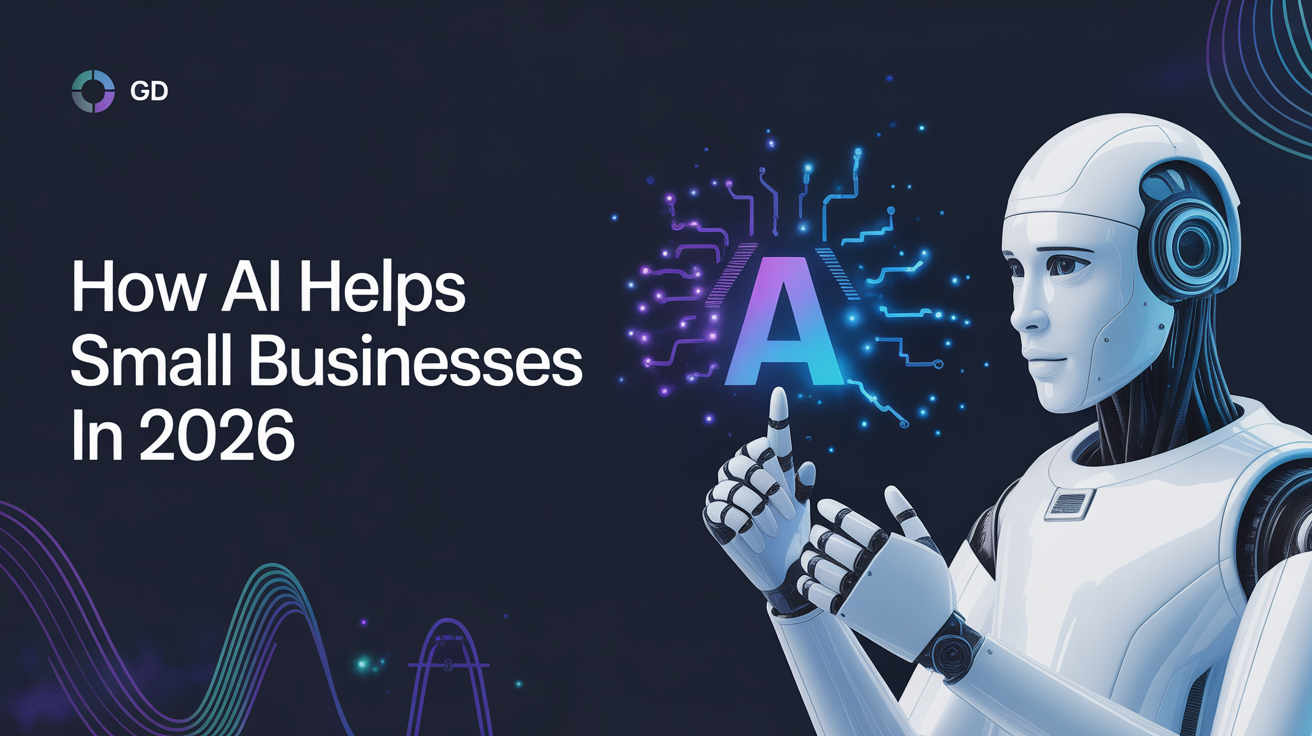
In 2026, artificial intelligence has quietly become one of the most influential forces shaping the future of small businesses. Unlike earlier waves of technology that favored large enterprises with deep pockets, AI has evolved into a practical, affordable, and scalable advantage for small and medium-sized businesses. What was once considered experimental or optional is now deeply integrated into daily operations, decision-making, customer engagement, and long-term strategy. How AI Helps Small Businesses in 2026.
Small businesses today face intense pressure. Customer expectations are higher than ever, operational costs continue to rise, digital competition is relentless, and attention spans are shrinking. In this environment, AI is not a luxury. It is a stabilizer, an accelerator, and, in many cases, a survival tool.
This article explores how AI helps small businesses in 2026, focusing on real-world impact, practical applications, and sustainable growth. The goal is to provide a clear, editorial-level understanding of how AI is reshaping small business operations without exaggeration or technical noise.
Table of Contents
AI in 2026: A Practical Business Tool, Not a Trend
By 2026, AI is no longer discussed as a futuristic concept. It exists inside tools that small businesses already rely on: accounting software, marketing platforms, customer support systems, inventory tools, and content management systems. Business owners may not even label what they use as “AI,” yet they benefit from it daily.
The shift happened gradually. Cloud computing reduced infrastructure costs. Software-as-a-Service models lowered entry barriers. User-friendly interfaces eliminated the need for technical expertise. Most importantly, competitive pressure forced businesses to become more efficient.
AI is now embedded, invisible, and operational.
For small businesses, this evolution matters because it changes how work gets done. Tasks that once required multiple employees or external agencies can now be handled by intelligent systems that operate continuously and improve over time.
Why AI Is Especially Valuable for Small Businesses
Small businesses operate under constraints that large enterprises often do not face. Limited staff, limited budgets, and limited time force owners to prioritize ruthlessly. AI directly addresses these constraints.
AI helps small businesses by:
- Reducing manual workload without increasing headcount
- Improving decision-making with data-backed insights
- Creating consistency in customer experience
- Allowing faster adaptation to market changes
Unlike traditional automation, modern AI systems learn from data. They refine outputs, recognize patterns, and adapt to new inputs. This learning capability is what gives small businesses leverage.
In 2026, AI has become an equalizer. It does not eliminate competition, but it narrows the gap between small businesses and larger players.
Transforming Customer Experience Through AI
Customer experience has become one of the most decisive factors in business success. Speed, relevance, and availability are no longer optional. AI plays a central role in meeting these expectations.
AI-powered customer interaction tools handle inquiries, resolve common issues, and guide users through processes without delay. Customers receive immediate responses, regardless of time zones or business hours.
Beyond speed, AI improves relevance. Customer data allows systems to recognize preferences, past behavior, and intent. This enables more personalized interactions that feel intentional rather than generic.
Key impacts of AI on customer experience include:
- Reduced response times across channels
- Consistent communication tone and accuracy
- Personalized product or service recommendations
- Improved customer satisfaction and retention
In 2026, customers rarely distinguish between small and large businesses when it comes to service expectations. AI helps small businesses meet those expectations reliably.
AI and the Evolution of Marketing Strategy
Marketing has traditionally been one of the most resource-intensive functions for small businesses. Budget limitations often force owners to rely on intuition rather than data. AI has changed this dynamic.
AI-driven marketing tools analyze customer behavior, engagement patterns, and conversion data in real time. Campaigns are optimized continuously rather than adjusted after results decline.
Instead of broad targeting, AI enables precision.
Small businesses now use AI to:
- Identify high-intent audiences
- Personalize email and ad messaging
- Optimize publishing times and formats
- Predict which leads are most likely to convert
This shift reduces wasted spend and improves return on investment. Marketing becomes less about experimentation and more about informed iteration.
AI also supports content performance by identifying what topics, formats, and keywords resonate most with audiences. This has direct implications for organic traffic, brand authority, and long-term visibility.
Operational Efficiency and Workflow Automation
Operational inefficiency is one of the most common growth barriers for small businesses. AI addresses this problem by automating repetitive and time-consuming tasks.
In 2026, AI-driven automation is not limited to manufacturing or logistics. It is embedded across service-based and digital businesses as well.
Common areas where AI improves operations include:
- Invoice generation and payment tracking
- Appointment scheduling and reminders
- Order processing and confirmation
- Data entry and record management
Automation does not eliminate human involvement. Instead, it removes friction from routine processes, allowing staff to focus on work that requires judgment, creativity, and relationship-building.
The result is improved productivity without burnout.
Smarter Financial Management and Forecasting
Financial uncertainty is one of the leading causes of small business failure. AI-powered financial tools now provide clarity that was previously unavailable without dedicated finance teams.
These systems analyze historical data, current performance, and external trends to generate forecasts and alerts. Business owners gain early visibility into potential cash flow issues, expense anomalies, or revenue fluctuations.
AI supports financial decision-making by:
- Forecasting short-term and long-term cash flow
- Identifying unnecessary or rising expenses
- Generating real-time financial reports
- Supporting scenario-based planning
In 2026, financial intelligence is no longer reactive. AI allows small businesses to plan proactively, reducing risk and improving resilience.
Inventory, Supply Chain, and Demand Planning
For product-based businesses, inventory management is a delicate balance. Overstocking ties up cash. Understocking leads to missed sales. AI improves this balance through predictive analysis.
By analyzing sales history, seasonality, market trends, and customer behavior, AI systems predict demand more accurately than manual methods.
Benefits include:
- Optimized stock levels
- Reduced waste and storage costs
- Improved supplier planning
- Better fulfillment reliability
Even service-based businesses benefit from demand forecasting when planning staffing, resources, and capacity.
AI in Hiring and Workforce Management
Hiring remains one of the most complex and costly processes for small businesses. AI reduces inefficiencies without removing human oversight.
AI-assisted hiring tools help screen resumes, match candidates to role requirements, and streamline interview scheduling. This reduces time-to-hire and improves candidate quality.
In workforce management, AI helps with:
- Shift scheduling
- Performance tracking
- Training recommendations
- Employee engagement analysis
Rather than replacing human managers, AI provides insights that support better leadership decisions.
Content Creation, SEO, and Digital Visibility
Online visibility is essential for small businesses, yet consistent content creation is often a challenge. AI now plays a supportive role in content workflows.
AI-assisted tools help generate drafts, optimize structure, improve readability, and align content with search intent. Human input remains critical for originality, tone, and expertise, but AI removes the friction of starting from scratch.
AI supports digital growth by:
- Identifying high-potential keywords
- Structuring SEO-friendly content
- Improving content consistency
- Repurposing content across platforms
This hybrid approach aligns with modern search engine guidelines that prioritize helpful, human-centered content.
AI Tools Across Core Business Functions
| Business Function | Role of AI | Outcome |
|---|---|---|
| Customer Support | Virtual agents and chatbots | Faster resolution |
| Marketing | Predictive targeting and personalization | Higher ROI |
| Finance | Forecasting and analytics | Better planning |
| Operations | Workflow automation | Time savings |
| Content | SEO and editorial assistance | Increased traffic |
| HR | Resume screening and scheduling | Improved hiring |
This integration across functions highlights how AI operates as an ecosystem rather than a standalone feature.
The Measurable Benefits of AI Adoption
When implemented intentionally, AI delivers tangible outcomes for small businesses.
Key benefits observed in 2026 include:
- Lower operational costs
- Increased employee productivity
- Improved customer retention
- More predictable revenue streams
- Stronger digital presence
These outcomes are cumulative. Small gains across multiple areas compound into significant competitive advantage over time.
Challenges and Responsible Adoption
Despite its advantages, AI requires responsible use. Data privacy, security, and ethical considerations remain critical.
Small businesses must ensure:
- Compliance with data protection regulations
- Transparency in customer interactions
- Balanced reliance on automation
- Ongoing human oversight
AI works best as a decision-support system, not a decision replacement system.
A Practical Approach to AI Implementation
Successful AI adoption in 2026 is deliberate, not rushed.
A practical approach includes:
- Identifying one clear business problem
- Selecting a focused AI solution
- Measuring impact over a defined period
- Scaling only after results are proven
This measured strategy reduces risk and maximizes return on investment.
The Road Ahead: AI Beyond 2026
AI will continue evolving, but its role in small businesses will remain centered on efficiency, insight, and adaptability.
Emerging developments include:
- Voice-based customer interactions
- Predictive customer retention models
- Deeper personalization at scale
- Greater integration across platforms
Small businesses that build AI literacy today will adapt more easily tomorrow.
Conclusion
In 2026, AI is no longer about innovation for its own sake. It is about building businesses that are resilient, efficient, and capable of sustained growth.
AI helps small businesses by removing friction, clarifying decisions, and amplifying human effort. It does not replace creativity, relationships, or leadership. It strengthens them.
For small businesses navigating an increasingly complex digital economy, AI is not a shortcut. It is a foundation.
Those who use it thoughtfully will not just keep up, they will lead.
Also Read: “Top AI Tools Everyone Should Know“
FAQs
How does AI help small businesses grow in 2026?
AI helps small businesses grow in 2026 by automating routine tasks, improving customer experience, and enabling data-driven decision-making. It allows businesses to operate more efficiently, personalize marketing efforts, forecast demand accurately, and scale operations without significantly increasing costs or staff.
Is AI affordable and practical for small businesses?
Yes, AI is both affordable and practical for small businesses in 2026. Most AI tools are available through subscription-based cloud platforms that require no technical expertise. Small businesses can start with low-cost AI solutions for customer support, marketing, accounting, or content creation and scale as they see measurable results.
Will AI replace human jobs in small businesses?
AI does not replace human jobs in small businesses; it supports them. In 2026, AI is mainly used to handle repetitive and time-consuming tasks, allowing employees to focus on creativity, customer relationships, and strategic work. Businesses that use AI responsibly often see improved productivity rather than job loss.