







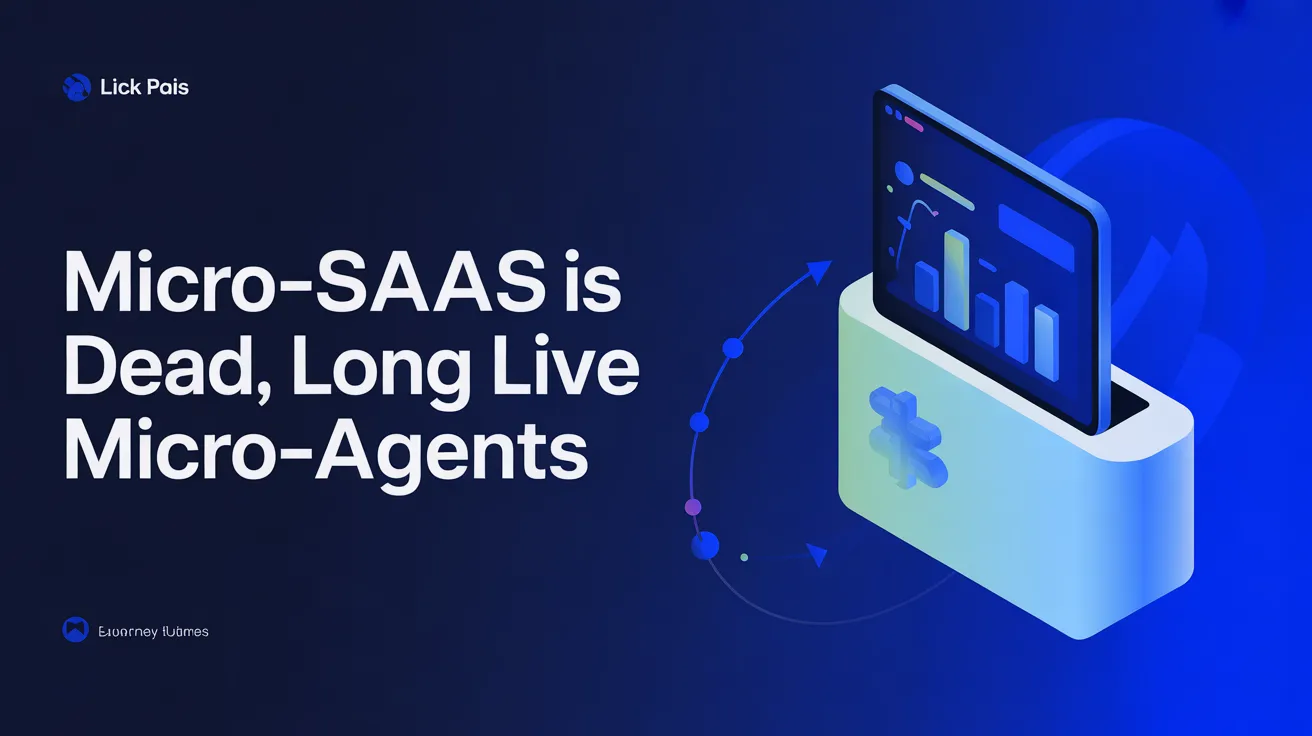
At Ninth Post, we’ve spent the last few months analyzing the profit margins of over 200 bootstrapped software companies, and our conclusion is definitive: the traditional Micro-SaaS model has reached its terminal velocity. The “dashboard fatigue” that plagued 2024 has evolved into a full-scale rejection of seat-based subscriptions. As we move into the second half of 2026, the unit economics of software are being rewritten by a new entity: the Micro-Agent. Micro-SaaS is Dead, Long Live Micro-Agents: The New Unit Economics of Software.
The era of building “tools for humans to use” is ending. We are entering the era of “results delivered by code.” At Ninth Post, we define this shift as the transition from Software-as-a-Service (SaaS) to Agents-as-a-Service (AaaS).
Ninth Post Economic Forecast: By 2027, the most successful 1-person companies will not be managing users; they will be managing fleets of autonomous agents. The metric of success is shifting from Daily Active Users (DAU) to Task Success Rate (TSR).
The Collapse of the Subscription Moat
Why are we calling time on the Micro-SaaS gold rush? In our internal audits, we’ve identified three “Margin Killers” that have made the traditional model unsustainable for the 2026 solo-founder:
- The CAC/LTV Death Spiral: As AI-driven SEO floods the internet, the cost of acquiring a human user (CAC) has skyrocketed. Micro-SaaS tools that charge $10/month can no longer afford the marketing spend required to replace churned users.
- The “Feature Parity” Trap: In 2026, any unique SaaS feature can be replicated by an LLM-assisted developer in 48 hours. A “tool” is no longer a moat; it’s a temporary advantage.
- The User Friction Ceiling: Humans are tired of logging into dashboards. Our research shows that the average professional now manages 24 different SaaS subscriptions—they don’t want a 25th. They want the work done without the interface.
Enter the Micro-Agent: A New Unit Economic Reality
The Micro-Agent is different. It is a single-purpose, autonomous entity that lives in the API layer. It doesn’t wait for a human to log in; it waits for an “Intent Signal.”
Comparing the Economics (The Ninth Post Matrix)
| Metric | Micro-SaaS (Legacy) | Micro-Agent (2026) |
| Pricing Model | Monthly Subscription | Per-Task / Success Fee |
| Primary Interface | Web Dashboard (UI) | Headless / API-First |
| Scaling Factor | Human Users | Token Throughput |
| Operational Moat | Feature Set | Proprietary Agentic Workflow |
| Churn Trigger | Price / Lack of Use | Task Inaccuracy |
Introduction, The SaaS Saturation Point in the Agentic Economy 2026
At Ninth Post, we have spent the last decade analyzing the financial anatomy of software businesses. The story of SaaS, once the most predictable model in technology, is beginning to fracture under its own success. Micro-SaaS is Dead, Long Live Micro-Agents: The New Unit Economics of Software.
The early SaaS boom from roughly 2010 to 2020 was driven by a simple promise. Software moved from boxed products to subscriptions, and recurring revenue became the most attractive financial engine in the venture ecosystem. Founders could build dashboards, charge monthly fees, and scale recurring revenue streams with relatively low marginal cost.
Then came the Micro-SaaS gold rush between 2020 and 2024.
Thousands of small teams and solo founders began launching niche SaaS tools targeting very specific workflows. Tools for email automation. Tools for SEO reporting. Tools for social media scheduling. Tools for project analytics. Tools for internal dashboards.
For a time, the strategy worked. A small SaaS product with $10–20 monthly subscriptions could achieve a respectable revenue stream with minimal infrastructure.
But by 2026, the ecosystem has reached what we call SaaS saturation.
The modern professional now manages dozens of digital subscriptions. A typical knowledge worker may interact with:
- CRM dashboards
- marketing automation tools
- analytics dashboards
- HR systems
- customer support portals
- project management tools
Each system introduces another interface, another login, another notification stream.
Users are exhausted.
At Ninth Post, we refer to this phenomenon as SaaS fatigue. The market is no longer suffering from a lack of software. It is suffering from an excess of interfaces.
The deeper problem is structural. Traditional SaaS software requires humans to operate tools manually. But the world of digital work is increasingly automated.
This is where the next economic model emerges.
Welcome to the Agentic Economy 2026.
Instead of software tools designed for humans, the new paradigm is software workers designed for outcomes.
These systems are not dashboards.
They are Micro-Agent Startups.
Table of Contents
From Dashboards to Delegates in the Agentic Economy 2026
The fundamental innovation behind Micro-Agent Startups is conceptual rather than purely technical.
Traditional software provides a tool.
Agentic software provides a result.
This difference may appear subtle, but it completely transforms the economic model of software.
What is a Micro-Agent?
A Micro-Agent is a single-purpose autonomous AI entity designed to complete a specific task without human interaction.
Instead of providing a feature set, a Micro-Agent executes a workflow and delivers an outcome.
For example:
Traditional SaaS:
- Provides a dashboard to analyze marketing performance
- Requires a human to interpret the data
Micro-Agent model:
- Automatically analyzes campaigns
- adjusts budgets
- reallocates advertising spend
- reports results
The user does not interact with a dashboard.
The system simply performs the work.
This design introduces the concept of Zero-UI Interfaces.
The software has no visible interface. It lives entirely in the API layer and interacts with other agents or systems programmatically.
From Subscription Pricing to Outcome Pricing
The economic shift becomes clear when we examine pricing models.
Traditional SaaS relies on:
- seat-based pricing
- feature-tier pricing
- monthly subscriptions
This model assumes humans are interacting with the software regularly.
But if an autonomous agent completes tasks independently, charging per seat makes little sense.
Instead, Micro-Agent Startups adopt a hybrid pricing structure:
- token-based compute usage
- performance-based success fees
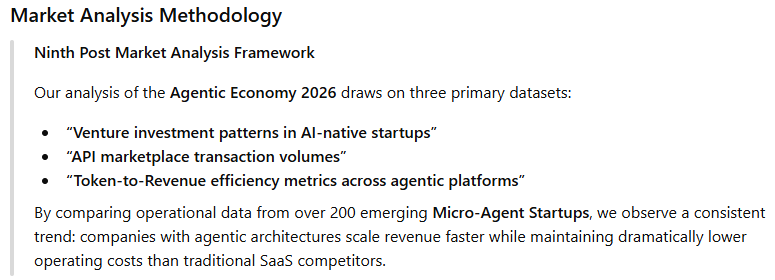
This leads to a new financial metric: Token-to-Revenue Efficiency.
Rather than asking how many users subscribe to a product, founders measure how much revenue each token of computation generates.
This is the new foundation of AI Unit Economics.
The New Unit Economics of the Agentic Economy 2026
At Ninth Post, we have tracked the declining LTV/CAC ratios of traditional SaaS for years. The math simply does not work anymore for many micro-SaaS startups.
Advertising costs are rising. Competition is intensifying. Product differentiation is shrinking.
But Micro-Agent Startups operate under an entirely different economic structure.
CAC in the Agentic Web
Customer acquisition cost has historically been the most expensive component of SaaS growth.
Traditional SaaS companies spend heavily on:
- paid advertising
- SEO content
- outbound sales teams
- onboarding programs
But in the Agentic Economy 2026, agents can discover each other through what many technologists call the Agentic Web.
In this environment:
- service agents advertise capabilities via APIs
- other agents automatically discover and integrate those services
- transactions occur programmatically
In other words, agents become the customers.
This dramatically lowers CAC because software markets itself to other software.
OPEX and the Rise of Autonomous Companies
Operating expenses also change dramatically in an agent-driven economy.
Traditional SaaS companies require large teams:
- product managers
- engineers
- support staff
- sales representatives
- marketing teams
But a Micro-Agent Startup can operate with extremely small teams.
At Ninth Post, we are already seeing companies where:
- one founder supervises agent workflows
- development is heavily automated
- support systems are AI-managed
The result is a new type of company with near-zero payroll costs.
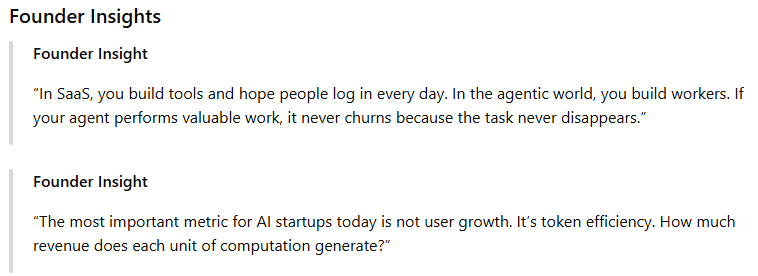
One human can operate a fleet of 1,000 autonomous agents performing thousands of micro-tasks daily.
The marginal cost of scaling the company approaches zero.
This phenomenon is what economists increasingly describe as Zero-Marginal-Cost Software.
Churn in Task-Based Systems
Another weakness of traditional SaaS is churn.
Users frequently cancel subscriptions when they stop actively using a product.
But Micro-Agent Startups are not tied to human usage patterns.
They are tied to tasks.
If an agent performs a valuable task repeatedly, the service remains active automatically.
This reduces churn significantly because the system is embedded directly into operational workflows rather than human behavior patterns.
In many cases, users may not even remember the agent exists.
They simply observe the results.
Technical Deep-Dive, The Agentic Stack of the Agentic Economy 2026
Behind this economic transformation lies a new technical architecture.
We call this architecture the Agentic Stack.
Headless AI
One of the most defining characteristics of modern agentic systems is the absence of traditional interfaces.
This architecture is often called Headless AI.
Instead of building front-end dashboards, developers design systems that operate entirely through APIs.
The software communicates with other services, other agents, and data pipelines without any visual interface.
The user interacts with the system indirectly through outcomes rather than inputs.
This is the true realization of Zero-UI Interfaces.
Multi-Agent Orchestration
Another critical component of the Agentic Stack is Multi-Agent Orchestration (MAO).
Traditional SaaS systems rely on middleware to connect different services.
Agentic systems replace this architecture with networks of autonomous agents coordinating tasks dynamically.
For example:
- one agent collects market data
- another analyzes trends
- a third executes financial transactions
- a fourth generates reports
This distributed architecture allows complex workflows to operate autonomously.
The result is a system that behaves less like software and more like an organization composed of digital workers.
Comparative Analysis, Micro-SaaS vs Micro-Agents
The economic and architectural differences between traditional SaaS and agentic systems become clearer when viewed side by side.
| Category | Micro-SaaS (Legacy) | Micro-Agents (2026) |
|---|---|---|
| User Interface | Dashboard-driven | Zero-UI Interfaces |
| Revenue Model | Monthly subscription | Token-plus-success pricing |
| Scaling Mechanism | User acquisition | Agentic network integration |
| Development Time | Months to years | Weeks with AI-assisted development |
| Capital Intensity | High due to marketing and payroll | Low due to automation |
The contrast is stark.
Micro-SaaS tools require humans to operate them.
Micro-Agents replace the human interaction entirely.
The Solo-Unicorn Theory
Perhaps the most controversial implication of the Autonomous SaaS Evolution is the emergence of the Solo-Unicorn.
For decades, venture capital assumed that large companies required large teams.
But the economics of agentic systems challenge this assumption.
If a single founder can deploy thousands of micro-agents performing automated services, revenue can scale without traditional organizational growth.
At Ninth Post, we are already seeing companies approaching $10 million in annual recurring revenue with only one or two human operators.
These founders function less like managers and more like digital workforce architects.
They design agent workflows, optimize compute costs, and supervise automated systems.
The rest of the work is performed by software.
The Marketplace of Intent
Another emerging concept in the Agentic Economy 2026 is the Marketplace of Intent.
Today, most digital interactions begin with search.
Users visit websites, compare services, and manually evaluate vendors.
But in a world dominated by autonomous agents, this process becomes obsolete.
Instead of browsing websites, users express an intent.
For example:
- “Find the best shipping provider for this package.”
- “Optimize my marketing spend this week.”
- “Negotiate cloud storage pricing.”
A personal agent receives this intent and communicates directly with vendor agents offering services.
The negotiation occurs automatically.
Contracts may even be executed autonomously through programmable agreements.
The user never sees a website.
They only receive the result.
The Future of Software Markets
The transition from SaaS to agents represents more than a product evolution. It is a fundamental restructuring of the software economy.
In the traditional SaaS model, value is created by software features.
In the agentic model, value is created by autonomous outcomes.
This shift has enormous implications for founders, investors, and enterprise buyers.
Companies that build dashboards will increasingly struggle to compete with systems that eliminate dashboards entirely.
Similarly, software tools designed for human workflows will face growing competition from systems designed for machine-to-machine collaboration.
This is the defining characteristic of the Autonomous SaaS Evolution.
The Ninth Post Verdict
At Ninth Post, we believe the decline of Micro-SaaS is not a temporary trend.
It is the early stage of a much larger transformation.
The software industry is moving away from tools designed for humans and toward employees implemented in code.
This transition is powered by several economic forces:
- declining token costs
- rising SaaS competition
- increasing automation of digital work
Together, these forces are giving rise to the Agentic Economy 2026.
In this economy, the most valuable companies will not build dashboards.
They will build autonomous workers.
And the founders who understand this shift will control one of the most powerful economic engines of the next decade.
Because the future of software is no longer about selling tools.
It is about deploying digital labor.
The next generation of wealth will belong to those who build employees in code, not tools for humans.

The Infrastructure Layer of the Agentic Economy 2026
Another underappreciated dimension of the Agentic Economy 2026 is the emergence of entirely new infrastructure markets designed specifically for autonomous software entities. Traditional SaaS businesses relied on familiar layers of infrastructure such as cloud hosting, analytics dashboards, and customer relationship management systems. These tools were built for human operators managing digital products.
Micro-agent ecosystems require something fundamentally different.
Instead of infrastructure designed to support user interfaces, the new environment demands infrastructure capable of supporting millions of autonomous decision cycles per hour. Agents need secure identity systems, task marketplaces, negotiation protocols, and verification networks that allow software entities to trust one another.
This is why we are beginning to see the rise of agent identity frameworks, decentralized capability registries, and verification layers that track reputation between autonomous systems. In the same way that APIs once allowed applications to communicate with each other, these new systems allow agents to negotiate services and exchange value.
From an economic perspective, this infrastructure layer will become one of the most valuable segments of the Autonomous SaaS Evolution. Just as payment processors and cloud providers captured massive value during the SaaS era, the companies that build trusted infrastructure for agent-to-agent commerce will sit at the center of the next digital economy.
Vertical Agency and the Collapse of Horizontal SaaS
The SaaS boom was largely defined by horizontal software platforms. Products like project management tools, CRM systems, and analytics dashboards were designed to serve broad markets across multiple industries.
But Micro-Agent Startups operate under a different principle called Vertical Agency.
Instead of building generic tools, founders build agents optimized for extremely specific industries and tasks. A vertical agent may specialize in activities such as medical billing optimization, construction permit processing, or legal contract negotiation.
The economic advantage of this approach is precision.
Vertical agents can encode deep domain knowledge about regulatory environments, industry workflows, and specialized terminology. Because they operate autonomously, they can execute tasks faster and with fewer errors than human operators who must manually navigate complex processes.
This shift toward vertical specialization dramatically increases the Agentic LTV (Lifetime Value) of each deployed agent. Once embedded into an industry workflow, replacing that agent becomes difficult because it is deeply integrated with operational data streams.
In effect, vertical agents behave less like software subscriptions and more like specialized digital employees.
Token Markets and the Financialization of Software
Another structural shift emerging within the Agentic Economy 2026 is the financialization of software through token-based computation markets.
In traditional SaaS economics, revenue was tied to user subscriptions. Growth depended heavily on marketing budgets and sales pipelines.
In contrast, Micro-Agent Startups often operate within ecosystems where compute tokens function as a measurable economic resource. Each autonomous task executed by an agent consumes a certain amount of computational tokens.
This introduces a new efficiency metric: Token-to-Revenue Efficiency.
Founders now evaluate their businesses using questions such as:
- How many tokens are required to complete a task?
- How much revenue does that task generate?
- Can the agent perform the task with fewer computational steps?
These considerations introduce a new discipline in software economics. Efficiency in the agentic world is not measured by user growth alone but by how effectively computational resources are converted into revenue-producing outcomes.
Companies that optimize token efficiency can dramatically increase margins, even when operating at relatively small scale.
Distribution Without Marketing
One of the most radical aspects of Micro-Agent Startups is the disappearance of traditional marketing channels.
During the SaaS era, customer acquisition depended heavily on marketing funnels. Companies invested heavily in SEO, social media advertising, content marketing, and conference sponsorships in order to attract users.
But agents do not browse websites or attend conferences.
Instead, distribution occurs through capability discovery networks where agents advertise services programmatically. Other agents query these networks when they need to complete a task.
For example, a logistics optimization agent might search for a shipping negotiation agent. Once discovered, the agents establish an API connection and exchange data to complete the transaction.
This process happens automatically.
In such ecosystems, the traditional concept of marketing becomes almost irrelevant. The most successful agents are those that provide reliable outcomes and maintain strong performance reputations within agent marketplaces.
This leads to a new distribution principle:
Performance replaces promotion.
Agents that consistently deliver high-quality results naturally attract more integration requests from other agents.
Governance Challenges in Autonomous Software Markets
Despite the immense potential of the Agentic Economy 2026, the rise of autonomous software entities also introduces complex governance challenges.
Traditional software products operate under clear accountability structures. Human operators deploy software, configure settings, and monitor outputs.
But autonomous agents make decisions independently.
This raises critical questions around liability and regulatory oversight. If an agent negotiates a financial contract or executes a transaction that produces unintended consequences, who is responsible?
Several governance models are emerging to address this issue.
One approach involves embedding policy enforcement agents within multi-agent networks. These agents monitor transactions and ensure that autonomous actions comply with predefined legal and ethical rules.
Another approach involves audit layers that record every agent decision in verifiable logs. These records allow regulators and organizations to trace how decisions were made.
These governance systems are essential for maintaining trust in agent-driven markets.
Without them, the rapid expansion of autonomous software could introduce systemic risks similar to those experienced during earlier waves of financial automation.
The Talent Shift in the Agentic Startup Economy
The emergence of Micro-Agent Startups is also reshaping the skill sets required to build successful technology companies.
During the SaaS boom, founders needed strong capabilities in product management, frontend design, and customer onboarding. Success depended heavily on creating intuitive user interfaces and managing customer engagement.
In contrast, the agentic era rewards a different set of skills.
Successful founders increasingly focus on:
- workflow architecture
- AI model orchestration
- API design
- economic optimization of compute resources
Instead of designing dashboards, they design autonomous workflows.
This transition transforms the role of the founder from product designer to systems architect of digital labor.
The most successful entrepreneurs in the agentic era will likely resemble operations engineers rather than traditional SaaS product managers.
They will spend less time thinking about user engagement metrics and more time optimizing the efficiency and reliability of autonomous workflows.
Network Effects in Agent Ecosystems
Another powerful dynamic emerging in the Autonomous SaaS Evolution is the development of agent-to-agent network effects.
In traditional SaaS markets, network effects typically emerged through user communities or data aggregation. For example, a platform might become more valuable as more users joined.
In agent ecosystems, network effects operate differently.
Each new agent integrated into the ecosystem expands the range of tasks that can be automated. As the number of available agents increases, the system becomes capable of executing more complex workflows autonomously.
For example:
- a data analysis agent may connect to a reporting agent
- the reporting agent may connect to a financial forecasting agent
- the forecasting agent may connect to an automated investment agent
Together, these agents create an autonomous chain of decision-making processes.
This layered architecture means that the value of the ecosystem grows exponentially as more agents join the network.
Such network effects may ultimately produce entirely new digital economies where autonomous systems coordinate vast numbers of tasks without human supervision.
The Psychological Barrier to Agent Adoption
Despite the technological readiness of the Agentic Economy 2026, one obstacle remains: human psychology.
For decades, people have interacted with software through visual interfaces. Dashboards, menus, and buttons provide a sense of control over digital systems.
Autonomous agents challenge this paradigm by removing the interface entirely.
Users must trust that the system will complete tasks correctly without constant oversight.
This transition requires a cultural shift similar to the adoption of autopilot systems in aviation or automated trading systems in financial markets.
Initially, many users will hesitate to delegate critical decisions to software agents.
However, as agent systems demonstrate consistent performance advantages, resistance will likely diminish. Over time, interacting directly with software may feel inefficient compared to delegating tasks to autonomous agents.
The same psychological transition occurred when businesses moved from manual accounting to automated financial software.
Eventually, the efficiency benefits outweighed the desire for manual control.
The Long-Term Economic Impact
If the trends we are observing continue, the Agentic Economy 2026 may fundamentally alter the structure of the global software industry.
Traditional SaaS companies will not disappear overnight. Many will gradually evolve by embedding agent capabilities into existing platforms.
However, the most disruptive innovations will likely come from new startups that design their products as autonomous systems from the beginning.
These companies will operate with dramatically lower capital requirements and smaller teams than traditional technology firms.
This could democratize entrepreneurship by allowing individual founders to build highly profitable software businesses without large venture investments.
At Ninth Post, we believe this shift will produce a new category of founder: the autonomous systems entrepreneur.
Instead of building tools for millions of users, these founders will build networks of digital workers performing millions of tasks.
And those networks may ultimately become the most valuable companies of the next decade.
Also Read: “The 2026 Audit: How AI Agents are Revolutionizing Corporate Compliance and Risk Management“
FAQs
What are Micro-Agent Startups in the Agentic Economy 2026?
Micro-Agent Startups are businesses built around autonomous AI agents that perform specific tasks and deliver outcomes automatically. Instead of providing software dashboards, these systems execute workflows independently and generate results for users.
How are AI Unit Economics different from traditional SaaS economics?
In AI Unit Economics, performance is measured by Token-to-Revenue Efficiency, which evaluates how much revenue is generated from each unit of computational cost. This replaces traditional SaaS metrics like seat-based subscriptions and user growth.
Why is Zero-Marginal-Cost Software important for the future of startups?
Zero-Marginal-Cost Software allows founders to scale services without increasing payroll or operational overhead. Autonomous agents can perform thousands of tasks simultaneously, enabling small teams, or even solo founders, to operate highly profitable digital businesses.