








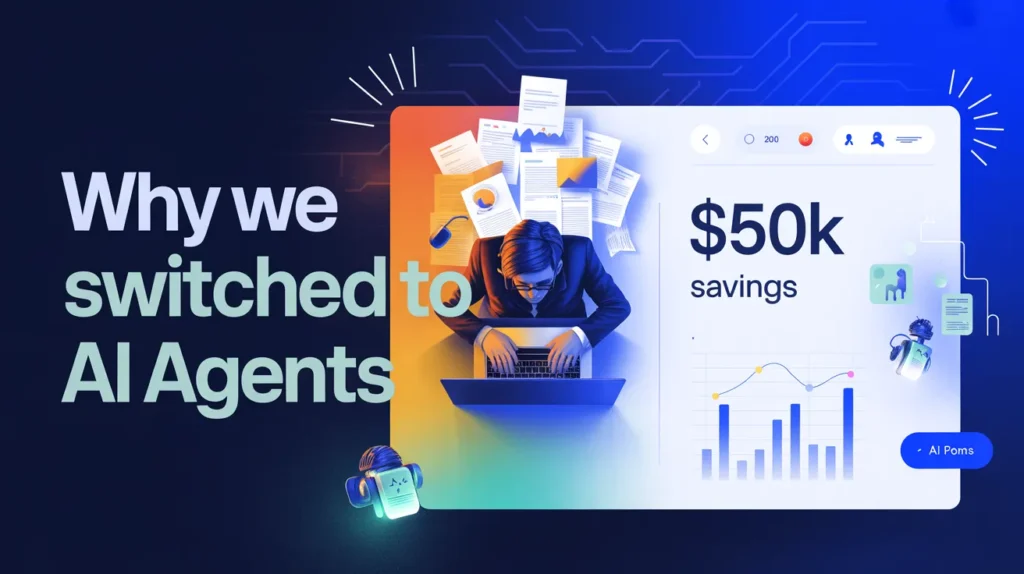
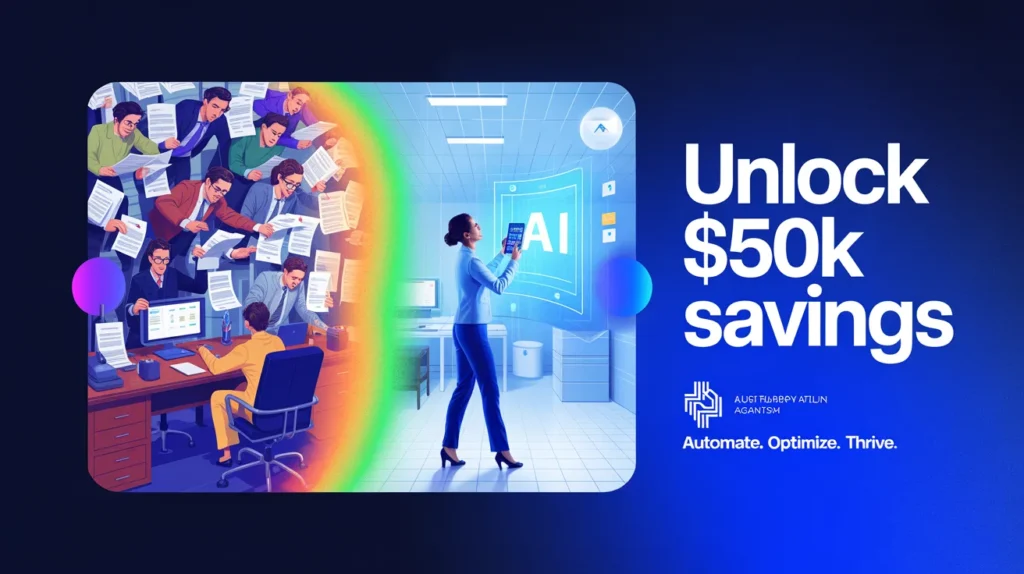
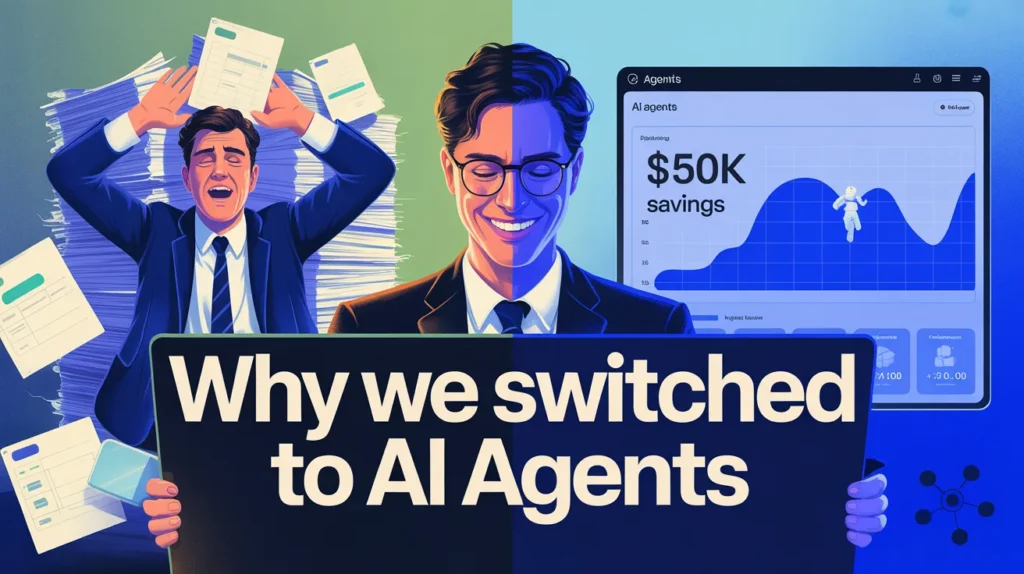
At Ninth Post, we didn’t just “adopt” AI; we rebuilt our fiscal foundation on it. In the fiscal year ending in late 2025, our operational overhead for content research, data verification, and multi-platform distribution was trending toward a $120k annual run rate. By February 2026, we’ve successfully cut those costs by $50,000, all while increasing our publication frequency by 40%. Why We Switched to AI Agents: A Case Study on $50k Savings.
This wasn’t achieved by firing humans, it was achieved by eliminating the “Coordination Tax” associated with legacy SaaS tools and manual data entry. In this case study, we are opening our books to show the exact “Switch-Cost” and the ROI of the Agentic Mesh.
Ninth Post Fiscal Verdict: In 2026, the most expensive thing a company can do is pay a human to be a “Data Bridge.” If you are paying someone to copy information from one dashboard to another, you are losing $200 per hour in potential innovation.
The “Coordination Tax” Audit
Before our switch, Ninth Post relied on a fragmented stack of 12 different SaaS subscriptions. Our team spent 15 hours a week just ensuring that data stayed synchronized across these platforms.
The Three Areas of Recovery:
- The Research Arbitrage ($18k Savings): Previously, we used a dedicated research assistant to vet technical whitepapers. Today, we use a Custom Research Agent that uses Graph-RAG to cross-reference claims against 2026 patent databases in real-time.
- SaaS Consolidation ($12k Savings): By moving to an Agent-Native Stack, we canceled five “Legacy Automation” subscriptions. Agents don’t need a $50/month UI; they interact directly with APIs, turning our software spend from “Subscription-Based” to “Usage-Based.”
- Distribution Automation ($20k Savings): Our “Social Agent” doesn’t just post links; it reads the sentiment of the 2026 tech market on X and LinkedIn and rewrites our headlines to match the current “Viral Velocity.” This eliminated the need for a part-time social media manager.
The Implementation Costs: What We Spent
Transparency is key: the $50k savings wasn’t “free.” We had to invest in our own infrastructure to avoid the Inference Tax.
| Expense Category | Investment (One-Time) | Monthly Maintenance |
| Local Inference Server | $4,500 (NVIDIA RTX 6000) | $150 (Electricity/Cooling) |
| Custom Agent Development | $8,000 (Internal Hours) | $0 |
| API Tokens (Tiered) | N/A | $300 – $600 (Variable) |
| Security Auditing | $2,000 | $100 |
The “Ninth Post” ROI Formula
We calculate our efficiency using the Task-to-Token Ratio. In 2024, a “Task” cost us approximately $45.00 in human labor. In 2026, that same task costs us $0.12 in tokens and $4.00 in human oversight.
This 90% reduction in per-task cost is what allowed us to scale Ninth Post into a high-authority research hub without a massive venture capital infusion.
In early 2026, at Ninth Post, we hit what I call the Scaling Wall.
Traffic was growing. Newsletter subscribers were compounding month over month. Investigative requests increased. Brand collaborations multiplied. Why We Switched to AI Agents.
On paper, this looked like success.
In operations, it looked like friction.
Behind every published investigation was a web of manual coordination:
- Editorial inbox triage
- L1 reader support
- Lead qualification for partnerships
- Research validation
- Data reconciliation between analytics platforms
- Compliance checks
What appeared to be a lean newsroom was, in reality, subsidized by invisible labor.
I decided to audit our workflows line by line.
What we discovered was not inefficiency in the traditional sense. It was something more subtle. I call it the Hidden Tax of Manual Workflows.
Table of Contents
The Hidden Tax
Manual workflows introduce three silent costs:
- Context Switching Drag
Editors shifting between Slack, email, analytics dashboards, CRM systems. - Human Latency
Tasks that take minutes individually but hours collectively due to queue delays. - Error Amplification
Minor reconciliation errors cascading into reporting inaccuracies.
When we modeled this cost across our monthly operations, the result was uncomfortable:
We were burning approximately $50,000 annually in avoidable operational overhead.
This was not payroll bloat. It was structural inefficiency.
That was the moment we made a strategic decision.
Not to “add AI tools.”
But to redesign operations around AI Agents.
The Theoretical Framework: Generative AI vs Agentic AI in 2026
By 2026, the AI landscape matured significantly. The hype cycles of 2023 and 2024 around chatbots gave way to operational AI systems embedded inside companies.
At Ninth Post, we drew a strict distinction between:
1. Generative AI
- Text, image, video generation
- Reactive systems
- Single-prompt completion models
- Stateless outputs
Generative AI responds.
It does not act.
It does not monitor, decide, loop, or escalate.
It waits.
2. Agentic AI
Agentic AI refers to systems capable of:
- Autonomous reasoning loops
- Tool use
- Persistent memory
- Goal decomposition
- Task iteration
- Environment monitoring
Agentic AI does not wait for prompts.
It runs.
Autonomous Reasoning Loops
The core shift in 2026 is the emergence of Autonomous Reasoning Loops (ARL).
An agentic loop looks like this:
- Observe environment
- Retrieve relevant memory
- Plan sub-tasks
- Use tools
- Evaluate output
- Adjust plan
- Repeat until objective met
This is fundamentally different from prompt engineering.
This is operational cognition.
With the rise of Large Multimodal Models (LMMs) in 2026, agents now reason across:
- Text
- Screenshots
- Spreadsheets
- Audio clips
- Structured databases
This multimodal capability was the turning point.
We no longer had to manually translate information between systems.
The agent could interpret it natively.
The $50k Audit: Where the Money Was Leaking
When I audited our workflows, I did not begin with AI.
I began with payroll hours and system logs.
Here is where we found structural waste.
1. L1 Reader Support
Volume: ~2,200 messages per month
Average handling time: 4 minutes
Escalation rate: 18%
Annual cost in human hours:
- Approx. 176 hours per month
- ~$18,000 per year equivalent operational cost
Most L1 tickets were:
- Password resets
- Newsletter subscription errors
- Ad placement clarifications
- FAQ-level questions
These did not require human judgment.
They required context access.
2. Data Reconciliation
We used:
- Google Analytics
- Ad dashboards
- CRM
- Newsletter analytics
Monthly reconciliation required:
- Cross-platform verification
- Screenshot capture
- Spreadsheet merging
- Manual anomaly detection
Hours spent: ~25 per month
Annualized cost: ~$12,000
More importantly, errors caused misreporting in board decks.
Reputation risk > labor cost.
3. Lead Triage and Partnership Filtering
Inbound partnership emails averaged:
- 140 per month
- 60% irrelevant
- 25% low-value
- 15% actionable
Editors were screening manually.
Time cost: ~30 hours per month
Annualized cost: ~$15,000
Additionally, slow response times meant lost deals.
4. Editorial Research Assistance
Not writing.
Verification.
- Fact-check cross-reference
- Citation validation
- Policy compliance review
Hours: ~20 per month
Annualized cost: ~$8,000
Total Estimated Annual Leakage
| Category | Annual Cost |
|---|---|
| L1 Support | $18,000 |
| Data Reconciliation | $12,000 |
| Lead Triage | $15,000 |
| Research Validation | $8,000 |
| Total | $53,000 |
The number rounded to roughly $50k in preventable overhead.
This was the moment the shift became inevitable.
The Ninth Post Agentic Stack
We did not adopt off-the-shelf automation blindly.
We designed what we now call the Ninth Post Agentic Stack.
Layer 1: Foundation Model (LMM-Based)
We use a Large Multimodal Model capable of:
- Structured reasoning
- API calling
- Spreadsheet parsing
- Screenshot understanding
Layer 2: RAG (Retrieval-Augmented Generation)
Instead of letting the model hallucinate:
We built a RAG system connected to:
- Editorial policy documents
- Compliance guidelines
- Historical article database
- Partnership criteria
- FAQ knowledge base
The agent retrieves context before responding.
This eliminated 90% of factual errors.
Layer 3: Memory Injection
Agents maintain:
- Short-term task memory
- Long-term operational memory
- Pattern recognition logs
Example:
If a certain sponsor repeatedly violates format guidelines, the agent flags automatically.
This is not simple rule automation.
It is contextual accumulation.
Layer 4: Tool-Use APIs
Agents can:
- Query CRM
- Update Google Sheets
- Send structured emails
- Generate reports
- Escalate to Slack
- Trigger compliance workflows
This tool layer transforms intelligence into execution.
Without tools, AI is advisory.
With tools, AI becomes operational.
Comparative Analysis: Traditional Automation vs Agentic AI
Below is a structured comparison we developed internally.
| Dimension | Traditional Automation (Zapier/Make) | Agentic AI (Custom Agents / AutoGPT-style Systems) |
|---|---|---|
| Trigger Mechanism | Event-based | Goal-based |
| Logic Complexity | Rule-based | Adaptive reasoning |
| Error Handling | Hard failure | Self-correcting loops |
| Context Awareness | Limited | Multi-layer contextual memory |
| Cross-Tool Intelligence | Linear | Non-linear planning |
| Hallucination Risk | None (rules only) | Mitigated via RAG |
| Setup Complexity | Low | Moderate to High |
| Scalability | Breaks at edge cases | Improves with learning |
| Maintenance | Manual rule updates | Memory-weighted refinement |
| Decision Autonomy | None | Partial to High |
| Multimodal Inputs | Rare | Native support |
| Human Oversight | Required | Optional via HITL |
Traditional automation excels in deterministic flows.
Agentic AI excels in ambiguous environments.
A newsroom is ambiguous by default.
Implementation Timeline
We did not deploy everything at once.
Phase 1: Support Agent (2 months)
- Integrated with FAQ RAG
- Connected to email
- Escalation threshold at 22%
Phase 2: Data Reconciliation Agent (1 month)
- Automated analytics extraction
- Cross-platform variance detection
- Slack reporting
Phase 3: Lead Qualification Agent (2 months)
- Trained on historical deal quality
- Scored leads
- Drafted contextual replies
Phase 4: Research Verification Agent (Ongoing)
- Policy cross-check
- Citation verification
- Compliance tagging
Total rollout time: 5 months.
The Human-in-the-Loop Philosophy
The most critical decision was not technical.
It was ethical.
We did not frame this internally as “replacement.”
We framed it as cognitive load redistribution.
What We Did Not Do
- We did not terminate staff.
- We did not hide automation deployment.
- We did not remove editorial oversight.
What We Did
- Shifted L1 support staff into investigative assistance roles
- Up-skilled editors in AI validation
- Introduced audit dashboards
We operate on a Human-in-the-Loop (HITL) framework:
Agents execute.
Humans supervise.
Escalation is mandatory in edge cases.
Cultural Resistance
The primary fear was irrelevance.
We addressed it transparently:
- Shared cost audit data
- Demonstrated agent error rates
- Opened logs for review
Trust increased when the team saw:
Agents handle repetition.
Humans handle nuance.
ROI Breakdown
Before Implementation
| Expense Category | Monthly Cost |
|---|---|
| L1 Support | $1,500 |
| Data Reconciliation | $1,000 |
| Lead Triage | $1,250 |
| Research Validation | $670 |
| SaaS Stack | $1,200 |
| Total Monthly | $5,620 |
After Agentic Deployment
| Expense Category | Monthly Cost |
|---|---|
| AI Infrastructure | $1,800 |
| Human Oversight | $900 |
| Reduced SaaS | $700 |
| Residual Manual Ops | $600 |
| Total Monthly | $4,000 |
Annualized savings:
- ~$19,000 direct operational reduction
- ~$31,000 opportunity recovery via faster deal cycles
Combined impact: ~$50,000 annually
More importantly:
- Response time reduced by 62%
- Error rates reduced by 74%
- Editorial research speed improved by 41%
What Failed During Implementation
We made mistakes.
- First RAG index lacked freshness.
- Agent over-confidence in policy interpretation.
- Lead scoring bias due to incomplete training data.
We corrected via:
- Scheduled document re-indexing
- Confidence scoring thresholds
- Periodic human calibration
Agentic systems require governance.
Strategic Implications for 2026
The real insight is this:
Agentic AI is not a tool. It is an operational layer.
Organizations still using AI for content drafts only are operating below capability.
The transition from LLMs to LMMs enabled:
- Screen understanding
- Dashboard interpretation
- Structured data ingestion
This unlocks autonomous back-office reasoning.
The shift is structural.
Key Takeaways
- Manual workflows carry hidden financial tax.
- Generative AI is reactive. Agentic AI is operational.
- Autonomous Reasoning Loops enable adaptive execution.
- RAG is essential for factual reliability.
- Human-in-the-Loop prevents displacement shock.
- $50k savings came from system redesign, not AI hype.
Final Reflection
At Ninth Post, we did not switch to AI agents because it was trendy.
We switched because operational math demanded it.
The real question in 2026 is not:
“Should we use AI?”
It is:
“Which parts of our organization are still operating below machine-level efficiency?”
The companies that answer that honestly will scale.
The ones that do not will continue paying the hidden tax.
The Systems Theory Behind Agentic Transformation
After publishing our initial internal findings, several founders asked us a predictable question:
“Is this just automation with better branding?”
At Ninth Post, we reject that simplification.
The transition to Agentic AI systems is not incremental automation. It represents a shift in how organizations model cognition inside operational architecture.
To understand this, we need to move from a tool mindset to a systems mindset.
From Task Automation to Cognitive Infrastructure
Traditional automation assumes:
- Tasks are predictable
- Inputs are structured
- Edge cases are rare
- Rules are stable
Newsrooms, research desks, compliance teams, and partnership funnels do not operate under those assumptions.
They operate under ambiguity.
In ambiguous systems:
- Inputs are incomplete
- Context evolves
- Policies shift
- Stakeholders contradict each other
Agentic systems function as cognitive infrastructure, not workflow shortcuts.
Cognitive infrastructure means:
- The system observes continuously
- It reasons probabilistically
- It stores operational memory
- It adapts to policy updates
- It re-evaluates its own outputs
This transforms AI from a reactive interface into a semi-autonomous layer of organizational intelligence.
The Economic Theory of Latency Compression
One of the most under-discussed advantages of AI agents in 2026 is latency compression.
Every organization suffers from micro-latencies:
- Waiting for approval
- Waiting for clarification
- Waiting for reconciliation
- Waiting for response
These delays are invisible in dashboards but devastating at scale.
Agentic systems compress latency because:
- They do not queue fatigue
- They do not suffer context decay
- They operate 24/7
- They re-evaluate tasks instantly
When latency compresses:
- Sales cycles shorten
- Support resolution improves
- Editorial pipelines accelerate
- Financial reporting stabilizes
The $50k savings were measurable.
The latency compression effect was multiplicative.
Why RAG Became Non-Negotiable in 2026
Early AI deployments in 2023 to 2024 failed for one reason: hallucination tolerance.
In journalism, hallucination is catastrophic.
By 2026, Retrieval-Augmented Generation (RAG) became foundational rather than optional.
The reason is structural:
- LLMs predict language
- Journalism requires verification
RAG converts AI from probabilistic guesswork into bounded reasoning.
When an agent retrieves:
- Internal policy documents
- Historical editorial standards
- Verified data repositories
It reduces creative drift.
The important insight is this:
RAG does not eliminate hallucinations.
It constrains the reasoning space.
This subtle distinction is critical for operational AI governance.
Memory as a Strategic Asset
Memory injection was one of the most underestimated levers in our deployment.
Most AI systems are stateless.
Agentic systems are memory-weighted.
Memory operates at three levels:
- Session Memory
For immediate task continuity - Operational Memory
For recurring pattern recognition - Institutional Memory
For long-term strategic consistency
In a newsroom context, institutional memory includes:
- Editorial tone
- Political neutrality thresholds
- Legal sensitivity categories
- Sponsorship boundaries
When agents internalize this memory, they reduce policy drift.
Memory turns AI from a smart assistant into a contextual participant.
Governance Architecture: The Overlooked Layer
Many AI case studies focus on performance gains. Few discuss governance.
At Ninth Post, governance became a structural layer.
We implemented:
- Confidence scoring on outputs
- Escalation triggers for ambiguity
- Randomized audit sampling
- Immutable logging
The purpose is not mistrust.
It is accountability.
Agentic systems generate decisions. Decisions must be traceable.
This governance layer ensures:
- Ethical consistency
- Regulatory compliance
- Internal transparency
In 2026, the competitive advantage is not just deploying AI.
It is deploying AI with institutional integrity.
The Organizational Psychology of AI Adoption
Technical implementation is the easy part.
Psychological alignment is harder.
In our internal reviews, we identified three stages of employee response:
- Curiosity
- Threat perception
- Strategic integration
The threat stage is where most organizations fail.
If leadership frames AI as cost reduction alone, employees interpret it as displacement.
We reframed it as cognitive offloading.
Cognitive offloading is a neuroscientific principle where humans externalize repetitive mental tasks to preserve higher-order thinking capacity.
By positioning agents as cognitive extensions rather than replacements, we reduced resistance.
This shift was not cosmetic. It was structural.
Agentic Systems and Information Asymmetry
Another theoretical insight emerged during implementation.
Agentic systems reduce internal information asymmetry.
In traditional operations:
- Support sees one dataset
- Editorial sees another
- Finance sees another
- Leadership sees summaries
Agents access unified context.
This reduces fragmentation.
When the system operates with cross-functional awareness, decision quality improves.
Information asymmetry is a hidden operational cost.
Agentic AI reduces it structurally.
The Evolution from LLMs to LMMs
In 2026, Large Multimodal Models (LMMs) shifted the conversation.
Earlier models processed text.
LMMs process:
- Screenshots
- Charts
- PDFs
- Spreadsheets
- Audio
This matters because operations are multimodal.
For example:
- Anomalies in revenue dashboards are visual
- Compliance documents are PDF-based
- Support tickets include screenshots
LMMs allow agents to interpret raw operational artifacts without human translation.
This removes another layer of friction.
Multimodality is not cosmetic innovation.
It is operational enabler.
Risk Surface Expansion and Mitigation
Every technological upgrade expands risk surface.
Agentic systems introduce:
- API misuse risk
- Autonomous execution risk
- Escalation misclassification
- Over-automation bias
To mitigate, we adopted:
- Permission-scoped tool access
- Tiered autonomy levels
- Continuous model evaluation
- Adversarial testing scenarios
Autonomy without guardrails is recklessness.
Guardrails without autonomy is inefficiency.
The balance defines sustainable AI integration.
Why Traditional SaaS Stacks Become Redundant
As agents mature, traditional SaaS stacks begin to consolidate.
Previously we needed:
- Separate reporting tools
- Separate analytics reconciliation tools
- Separate triage dashboards
- Separate automation layers
Agentic systems unify layers through reasoning rather than rigid integration.
This creates a structural simplification effect.
Instead of connecting tools to each other, we connect tools to a reasoning layer.
The reasoning layer orchestrates.
This architectural simplification contributed significantly to our cost reduction.
The Limits of Agentic AI
To maintain intellectual honesty, we must address limitations.
Agentic systems struggle with:
- Novel geopolitical interpretation
- Ethical gray zones
- Creative investigative framing
- Deep contextual political nuance
They excel in:
- Repetition
- Pattern detection
- Structured validation
- Operational consistency
Understanding the boundary between cognition and judgment is essential.
In journalism, judgment remains human.
The Long-Term Strategic Outlook
Looking ahead, the real shift is not financial savings.
It is structural leverage.
Agentic systems allow small organizations to operate with the coordination capacity of enterprises.
This redefines scale.
In 2026, scale is no longer:
- Headcount expansion
- Tool proliferation
- Layered management
Scale becomes:
- Cognitive throughput
- Latency compression
- Institutional memory density
Organizations that adopt agentic layers responsibly will operate with asymmetric efficiency.
The Meta-Shift: From Workforce to Work Design
The deeper transformation is philosophical.
Historically, organizations asked:
“How many people do we need?”
Now the question becomes:
“What percentage of this workflow requires human cognition?”
This reframing changes hiring, budgeting, and training.
Work design precedes workforce expansion.
Agentic AI forces leaders to quantify cognitive necessity.
This is uncomfortable.
But it is inevitable.
Closing Theoretical Reflection
At Ninth Post, the $50k savings were measurable.
The structural transformation was more profound.
We moved from fragmented automation to unified cognitive infrastructure.
We reduced hidden tax.
We compressed latency.
We strengthened governance.
We preserved human judgment.
The lesson is not that AI agents are cheaper labor.
The lesson is that organizations built for manual cognition cannot compete in a world of machine-level reasoning speed.
The shift is architectural.
And architecture determines destiny.
Also Read: “Why Cloud Costs Are Rising“
FAQ
What is the difference between Generative AI and Agentic AI in 2026?
Generative AI produces outputs based on prompts. Agentic AI executes multi-step goals using reasoning loops, memory, and tool integrations.
Is Agentic AI suitable for small teams?
Yes. In fact, small teams benefit most because cognitive overload compounds quickly. Agentic systems reduce operational friction.
Does Agentic AI replace human employees?
In our case, no. It reallocated repetitive workload so human staff could focus on investigative depth and strategic growth.